Epitalon Research Guide
An evidence-mapped overview of Epitalon (also spelled Epithalon / Epithalone; sequence Ala-Glu-Asp-Gly, AEDG) covering compound identity, proposed mechanisms only as far as opened papers support them, published cell and rodent studies, regional human reports, laboratory considerations, and current evidence limitations.
Tetrapeptide AEDG
Investigational compound
Research use only
Educational information only. Epitalon is not an FDA-approved drug for human use. Laboratory research use only; not for human or animal use. The 10 mg and 40 mg listings are the same research tetrapeptide and share this page. No human dosing, reconstitution, or administration protocol appears here.
Quick Facts
Epitalon is a synthetic tetrapeptide, Ala-Glu-Asp-Gly (AEDG). It was synthesized from the amino-acid composition of Epithalamin, a bovine pineal-gland extract, and was later reported as a component of that pineal polypeptide complex (Araj et al., 2025, PMID 40141333, PMC11943447; Khavinson et al., 2017, PMID 29124531). Also spelled Epithalon / Epithalone.
PubChem CID 219042: title Epitalon; formula C14H22N4O9; computed molecular weight 390.35; IUPAC name (4S)-4-[[(2S)-2-aminopropanoyl]amino]-5-[[(2S)-3-carboxy-1-(carboxymethylamino)-1-oxopropan-2-yl]amino]-5-oxopentanoic acid; InChIKey HGHOBRRUMWJWCU-FXQIFTODSA-N. Synonyms include Epitalon, Epithalon, Epithalone, Ala-Glu-Asp-Gly, AE-0 peptide, UNII O65P17785G, CAS 307297-39-8, and also CAS 64082-79-7.
FDA UNII O65P17785G: preferred name EPITALON; formula C14H22N4O9; synonyms ALA-GLU-ASP-GLY, EPITHALON, 307297-39-8. UNII availability does not imply regulatory review or approval. NCATS Inxight O65P17785G: molecular weight 390.3459; stereochemistry absolute; 3/3 defined stereocenters; approval year Unknown. Curator note: most studies were conducted by the same institute that created the compound (St. Petersburg Institute of Bioregulation and Gerontology). The same record states the peptide “has not been approved for any therapeutic and/or prophylactic use by any government health authority in the USA or Europe.” NCATS also lists an FDA orphan-drug designation code 312010; designation is not approval.
Search both spellings (Epitalon and Epithalon) when matching a material to the literature. Confirm the four-residue sequence Ala-Glu-Asp-Gly. The SRP 10 mg and 40 mg vials are the same research tetrapeptide at two listed strengths. They share this page. PubChem CID 219042 lists “Epithalamin” among depositor synonyms for the tetrapeptide; that is an identity collision, not proof the extract and the tetrapeptide are the same material. CAS 64082-79-7 is used elsewhere for Epithalamin — treat as a collision.
What Epitalon is
Khavinson’s group synthesized AEDG from the amino-acid composition of the bovine pineal extract Epithalamin and later reported detecting free AEDG among tetrapeptides in that extract by selective-reaction-monitoring mass spectrometry (Khavinson et al., 2017, PMID 29124531). Araj et al. (2025) restated that origin story and summarized ~25 years of in-vitro, in-vivo, and in-silico work, while noting that physico-chemical and structural investigation of the peptide remains limited (PMID 40141333).
The published record is heavily concentrated in Bulletin of Experimental Biology and Medicine, Neuro Endocrinology Letters, Advances in Gerontology, and related regional titles, with a large share of papers from the St. Petersburg Institute of Bioregulation and Gerontology and collaborators (NCATS curator note; paper-by-paper authorship in the opened set). Independent work exists but is thinner: Djeridane / Touitou (Paris) on rat pineal melatonin (2003); Yue et al. (China) on mouse oocytes (2022); Al-Dulaimi / Roberts (Brunel, UK) on telomere length in cell lines (2025); Vanhee et al. (Belgian medicines control) on illicit vials (2015).
Opened identity records and primary papers give Ala-Glu-Asp-Gly (AEDG): L-alanyl-L-α-glutamyl-L-α-aspartyl-glycine (PubChem CID 219042; FDA UNII O65P17785G; Khavinson 2003, PMID 12937682; Anisimov 2003, PMID 14501183; Khavinson 2017, PMID 29124531). What those sources do not provide: a supplier-vial certificate for the SRP lots, a confirmed counter-ion on the SRP vials, or proof that a given research-market lot matches the St. Petersburg synthesis lots used in the papers. Sequence confirmation remains a laboratory identity step.
Only as far as sources support
The mechanism literature is proposed and context-dependent. Opened papers do not establish a single receptor, a crystal structure, or a human in-vivo occupancy study. Observed means AEDG / Epitalon / Epithalon as the test article. Proposed means a compiled or hypothesized mechanism. Not shown means this review did not open such a paper. There is no invented receptor diagram and no fake chart on this page.
Telomerase / telomere length in cultured human cells
Addition of Epithalon to telomerase-negative human fetal fibroblast culture induced catalytic-subunit expression, telomerase enzymatic activity, and telomere elongation (Khavinson, Bondarev, Butyugov, 2003, PMID 12937682). A follow-up from the same group reported that aging human fetal pulmonary fibroblasts lost proliferative potential at passage 34; Epithalon elongated telomeres toward early-passage length and the treated cells made 10 extra divisions (44 passages) versus control (Khavinson et al., 2004, PMID 15455129). These are cell-culture findings from one laboratory. They are not a human lifespan result.
Telomere / hTERT / ALT in cell lines
Al-Dulaimi, Thomas, Matta, and Roberts (Brunel) treated breast-cancer lines 21NT and BT474 plus normal epithelial and fibroblast cells. qPCR and immunofluorescence showed dose-dependent telomere-length extension in normal cells through hTERT and telomerase upregulation. In the cancer lines, telomere extension also occurred through ALT (alternative lengthening of telomeres); ALT increase was minor in normal cells (PMID 40908429; PMC12411320). This is still in vitro. The paper has a published erratum (PMID 41240216); findings used here are from the opened 2025 abstract, not from numbers that appear only in the unopened PDF.
PHA-stimulated human lymphocytes
In blood lymphocytes from young (18–22 y, n=5) and middle-aged (49–54 y, n=6) men, AEDG changed relative telomere length in 7 of 11 individuals (increase in 5, decrease in 2). The authors described a “tendency to normalization” versus the group mean. Mitotic index was largely unchanged (Khavinson et al., 2019, PMID 31761987). This is ex-vivo culture of donated blood, not an in-vivo human telomere trial.
Chromatin in cultured lymphocytes
In cultured lymphocytes from persons aged 76–80 years, Epitalon induced activation of ribosomal genes, decondensation of pericentromeric structural heterochromatin, and release of genes described as repressed by age-related euchromatin condensation (Khavinson et al., 2003, PMID 14647006). Cell culture, not an organismal aging trial.
Melatonin — conflicting results
Khavinson et al. (2012) reported that epithalone stimulated AANAT and pCREB synthesis and increased melatonin in rat pinealocyte culture (PMID 22816096). Djeridane, Khavinson, Anisimov, and Touitou (2003), using a perifusion device on pineal glands from young (9-week) and old (27-month) male Wistar rats, found that Ala-Glu-Asp-Gly had no significant effect on melatonin secretion and did not modify isoproterenol-stimulated melatonin. The authors concluded the tetrapeptide “does not seem to play a role, at least in vitro, in the control of melatonin secretion by the rat pineal gland” (PMID 12809170). Do not state “restores melatonin” as a settled fact. Report both results.
Neurogenic markers + histone model
In human gingival mesenchymal stem cells, AEDG increased Nestin, GAP43, β-tubulin III, and doublecortin protein and raised those mRNAs 1.6–1.8-fold. Molecular modelling suggested preferred binding to histones H1/6 and H1/3 at DNA-interacting sites (Khavinson et al., 2020, PMID 32019204; PMC7037223). That binding model is computational plus marker expression, not a solved co-structure of AEDG on chromatin in a living human.
Mouse oocyte aging
Yue et al. (2022) added Epitalon to cultured post-ovulatory mouse oocytes and reported lower ROS, fewer spindle and cortical-granule defects at 12–24 h, higher mitochondrial membrane potential and mtDNA copy number, and less apoptosis by 24 h (PMID 35413689; PMC9037278). In-vitro oocyte aging, not human fertility.
High-glucose ARPE-19 wound model
Gatta et al. (2025) reported that AEDG restored impaired scratch-wound closure in high-glucose-injured human retinal pigment epithelial cells and reduced hyperglycemia-associated EMT/fibrosis markers (PMID 40493162; PMC12356729). Cell monolayer, not a diabetic-retinopathy trial.
Compiled actions; mechanism uncertain
Araj 2025 lists antioxidant, neuroprotective, antimutagenic, melatonin, IL-2, thymocyte, AChE/BuChE, and telomerase effects and states it remains uncertain whether these are the sole mechanisms (PMID 40141333). Khavinson 2017 attributes the biological effects of the pineal polypeptide complex to its AEDG component (PMID 29124531). That is the authors’ interpretation of an identification study.
THP-1 / macrophage inflammation
Epitalon was one of five Khavinson peptides tested together as a class; all five inhibited LPS-stimulated TNF and IL-6 on differentiated THP-1 cells (Avolio et al., 2022, PMID 35408963; PMC8999041). Not an Epitalon-only binding study.
Gaps that matter
No defined cell-surface receptor, Ki table, or crystal structure for AEDG. No proof that marketplace vials reproduce St. Petersburg lot pharmacology. No human in-vivo telomere lengthening after a research-vial protocol. No human lifespan extension, delayed human aging, or a registered randomized longevity trial. No consistent, independently replicated melatonin mechanism (opened papers disagree in vitro). No oral human bioavailability or a research-vial PK curve. ClinicalTrials.gov v2 API search for epitalon OR epithalon OR epithalone OR AEDG returned an empty studies array.
Where the literature actually sits
Label every cluster. Epitalon-only means the test article was the synthetic tetrapeptide Ala-Glu-Asp-Gly / Epitalon / Epithalon / Epithalone / AEDG. Extract means Epithalamin / pineal polypeptide complex. Not found means this review did not open such a paper. The literature is regionally concentrated.
Sequence, registry, forensic ID
Sequence AEDG; later SRM detection of AEDG among tetrapeptides in a pineal polypeptide complex (Khavinson 2017, PMID 29124531). Registry: UNII O65P17785G; CAS 307297-39-8; C14H22N4O9; MW ~390.35 (PubChem CID 219042; FDA GSRS; NCATS). Vanhee et al. (2015) identified the tetrapeptide in two illegal pharmaceutical preparations marketed toward cancer, old age, and retinitis pigmentosa — an analytical/forensic letter, not an efficacy study (PMID 25535022).
Culture lifespan, lymphocytes, independent ALT panel
Human fetal fibroblasts: telomerase catalytic subunit, activity, telomere elongation (PMID 12937682); extra divisions past the culture limit (PMID 15455129). Cultured lymphocytes, ages 76–80: chromatin activation (PMID 14647006). PHA-stimulated lymphocytes from 11 men: mixed telomere-length change (PMID 31761987). Independent: normal and breast-cancer cell lines; telomerase vs ALT (Al-Dulaimi 2025, PMID 40908429).
hGMSC, oocytes, ARPE-19; class THP-1
hGMSCs: neuronal-marker gene/protein increase; histone-binding model (PMID 32019204). Independent: mouse oocytes in vitro (Yue 2022, PMID 35413689). ARPE-19 high-glucose scratch assay (Gatta 2025, PMID 40493162). Avolio 2022 tested five Khavinson peptides together on THP-1 cells (PMID 35408963) — not an Epitalon-only binding study.
SHR mean LS unchanged; HER-2/neu; light regimens
Female Swiss-derived SHR mice, n=54/group: mean lifespan unchanged; food intake and body weight unchanged; last 10% of survivors +13.3% (P<0.01); maximum lifespan +12.3%; chromosome aberrations −17.1% (P<0.05); total spontaneous tumor incidence unchanged; leukemia inhibited 6-fold (Anisimov et al., 2003, PMID 14501183).
Female FVB/N HER-2/neu transgenic mice: Epitalon reduced cumulative number and maximum size of mammary tumors; fewer mice with ≥2 tumors; smaller (not fewer) lung metastases; 3.7-fold reduction in HER-2/neu mRNA. Parallel Vilon (Lys-Glu) arm had worse tumor metrics than saline (Anisimov et al., 2002, PMID 12209581).
Female rats under standard / natural / constant light: Epithalon did not change lifespan under standard light; under natural and constant light it prolonged maximum and last-10% lifespan (Vinogradova et al., 2007, PMID 18856211). Male rats, same design: epithalone virtually did not change mean lifespan (Vinogradova et al., 2008, PMID 19110597). Female C3H/He mice: fewer mice with malignant tumors (Kossoy et al., 2006, PMID 16634527). Female SAMP-1 / SAMR-1: last-10% survival; epitalon did not change tumor frequency (Anisimov et al., 2005, PMID 15909815).
Perifusion negative; pinealocyte positive
No effect in rat pineal perifusion (Djeridane 2003, PMID 12809170). Increased melatonin / AANAT / pCREB in rat pinealocyte culture (Khavinson 2012, PMID 22816096).
Retina series and mixed melatonin report
Khavinson et al., 2002, Neuro Endocrinol Lett: Campbell-rat retinal preservation plus a statement that “Epitalon therapy in patients with degenerative retinal lesions results in a positive clinical effect in 90% of the cases” (PMID 12195242). The opened abstract does not give n, randomization, masking, endpoints, or a Western multicenter protocol. Treat as a regional report, not as proof of human efficacy.
Korkushko et al., 2007: Epithalamin and Epitalon described as recovering night melatonin and circadian amplitude in old monkeys and elderly people (PMID 17969590). Mixed extract + tetrapeptide; not a registered RCT; not a lifespan study.
Do not relabel as Epitalon
Papers on Epithalamin alone, “pineal peptides,” or combined pineal preparations without a separable AEDG arm. Do not relabel Epithalamin extract as AEDG.
ClinicalTrials.gov empty; no human lifespan paper
Not found in ClinicalTrials.gov. A ClinicalTrials.gov v2 API search for epitalon OR epithalon OR epithalone OR AEDG returned an empty studies array. No opened paper reported a completed, independently registered, randomized human longevity trial of this tetrapeptide. Human lifespan extension is not established. Fly lifespan is not a human result.
What was studied, in what system
Read the “compound actually studied” column first. Published study amounts are historical facts from those papers. They are not a protocol.
| Domain | Compound actually studied | System | Status | Source |
|---|---|---|---|---|
| Sequence / registry identity | Ala-Glu-Asp-Gly | PubChem / FDA UNII / NCATS | Identity only | CID 219042; UNII O65P17785G; CAS 307297-39-8 |
| AEDG in pineal complex | Peptide AEDG | HPLC / MS of epiphysis polypeptide complex | Identification | PMID 29124531 |
| Telomerase / telomere elongation | Epithalon (AEDG) | Telomerase-negative human fetal fibroblasts | Cell culture | PMID 12937682 |
| Extra divisions in culture | Epithalon (AEDG) | Human fetal pulmonary fibroblasts | Cell culture | PMID 15455129 |
| Chromatin activation | Epitalon | Cultured lymphocytes, ages 76–80 | Ex-vivo culture | PMID 14647006 |
| Lymphocyte telomere length | Peptide AEDG | PHA-stimulated blood lymphocytes, 11 men | Ex-vivo; mixed direction | PMID 31761987 |
| Neurogenic markers | AEDG / Epitalon | Human gingival MSCs; histone docking model | Cell + in silico | PMID 32019204 |
| Telomere / hTERT / ALT | Epitalon | Normal epithelial/fibroblast + 21NT, BT474 | Independent cell-line; ALT in cancer lines | PMID 40908429 |
| Post-ovulatory oocyte aging | Epitalon | Mouse oocytes in vitro | Independent cell/oocyte | PMID 35413689 |
| High-glucose RPE wound | AEDG / Epitalon | ARPE-19 monolayer | Cell culture | PMID 40493162 |
| Rat pineal melatonin (perifusion) | Ala-Glu-Asp-Gly | Young and old Wistar pineal glands | No effect | PMID 12809170 |
| Rat pinealocyte melatonin | Epithalone | Rat pinealocyte culture | Increased melatonin / AANAT / pCREB | PMID 22816096 |
| Mouse mean vs max lifespan | Epitalon | Female SHR mice; n=54/group | Mean LS unchanged | PMID 14501183 |
| HER-2/neu mammary tumors | Epitalon (Vilon parallel) | Female FVB/N HER-2/neu mice | Tumor burden down; Vilon worse | PMID 12209581 |
| Female rat LS under light stress | Epithalon | Female rats; 3 light regimens | No LS change in standard light | PMID 18856211 |
| Male rat LS under light stress | Epithalone | Male rats; 3 light regimens | Mean LS virtually unchanged | PMID 19110597 |
| C3H/He spontaneous tumors | Epitalon | Female C3H/He mice | Fewer malignant tumors / metastases | PMID 16634527 |
| Retina (rat + human report) | Epitalon (AEDG) | Campbell rats; regional patient report | Human 90% claim unsized | PMID 12195242 |
| Elderly melatonin (mixed) | Epithalamin and Epitalon | Old monkeys; elderly people | Regional; extract + tetrapeptide | PMID 17969590 |
| Illicit-product ID | Epitalon tetrapeptide | Two illegal pharmaceutical preparations | Analytical letter | PMID 25535022 |
| Registered human RCT | — | ClinicalTrials.gov v2 API | Empty study list | API opened this draft |
| Human lifespan | — | — | Not established | No opened longevity RCT |
How the record accumulated
Tumor-burden reduction; unsized 90% clinical claim
Anisimov et al.: Epitalon reduced mammary-tumor burden and HER-2/neu mRNA in transgenic mice; Vilon did the opposite on several tumor metrics (PMID 12209581). Khavinson et al.: Campbell-rat retina plus a 90% “positive clinical effect” statement in patients with degenerative retinal lesions (PMID 12195242).
Same year: culture telomerase and unchanged mean lifespan
Khavinson, Bondarev, Butyugov: telomerase and telomere elongation in human fetal fibroblasts (PMID 12937682). Anisimov et al.: female SHR mice; mean lifespan unchanged; maximum lifespan +12.3%; leukemia 6-fold lower (PMID 14501183). Djeridane / Touitou: no melatonin effect in rat pineal perifusion (PMID 12809170). Khavinson et al.: chromatin activation in cultured lymphocytes from people aged 76–80 (PMID 14647006).
Extra fibroblast divisions
Khavinson et al.: extra divisions in aging human fetal fibroblasts after telomere elongation (PMID 15455129).
C3H/He tumors; female and male rat light regimens
Kossoy 2006 C3H/He tumors (PMID 16634527). Vinogradova 2007 female rats: no lifespan change under standard light (PMID 18856211). Vinogradova 2008 male rats: mean lifespan virtually unchanged (PMID 19110597).
Opposite direction from Djeridane
Khavinson et al.: epithalone raised melatonin, AANAT, and pCREB in rat pinealocyte culture (PMID 22816096).
Illegal vials
Vanhee et al.: tetrapeptide identified in two illegal pharmaceutical preparations (PMID 25535022).
AEDG in pineal complex; mixed lymphocyte telomeres
Khavinson 2017: AEDG detected in pineal complex (PMID 29124531). Khavinson 2019: mixed telomere-length changes in 11 men’s lymphocytes (PMID 31761987). Khavinson 2020: neuronal markers in hGMSCs; histone model (PMID 32019204).
Oocytes, THP-1 class study, ARPE-19, Brunel ALT panel
Yue 2022 mouse oocytes (PMID 35413689). Avolio 2022 THP-1 class study (PMID 35408963). Araj 2025 narrative review (PMID 40141333). Gatta 2025 ARPE-19 (PMID 40493162). Al-Dulaimi 2025 Brunel cell-line telomere / ALT paper (PMID 40908429).
What is not established
These are gaps in the opened record. Treating any of them as settled is incorrect.
No human lifespan evidence
No opened paper is a randomized, independently registered human longevity trial. Anisimov 2003 did not change mean lifespan in female SHR mice. Vinogradova 2007 and 2008 reported little or no mean-lifespan change under a standard light cycle. Maximum-lifespan and last-decile effects in those rodent papers are not human lifespan. Do not write that Epitalon extends human life. Fly lifespan is not a human result.
ClinicalTrials.gov is empty
A ClinicalTrials.gov v2 API search for epitalon OR epithalon OR epithalone OR AEDG returned an empty studies array. No registered, independently replicated randomized trial with a pre-specified lifespan or telomere primary endpoint was found.
Literature is regionally concentrated
NCATS states most studies were conducted by the institute that created the compound. Many primary papers are short reports in Bull Exp Biol Med or Neuro Endocrinol Lett. Independent replications exist (Djeridane 2003; Yue 2022; Al-Dulaimi 2025; Vanhee 2015) but do not convert the file into a Western clinical evidence base.
SHR mice: mean lifespan unchanged
Anisimov 2003 (n=54/group to natural death): no change in mean life span, food intake, or body weight. Last-10% survivors +13.3%; maximum life span +12.3%. Those tail increments are not a human result.
Do not relabel Epithalamin extract as AEDG
Epithalamin is a multi-peptide pineal extract. Epitalon is a defined four-residue peptide. Do not cite extract papers, “pineal peptide” geriatric series, or mixed-preparation melatonin studies as tetrapeptide-only evidence unless the paper isolated AEDG as the test article.
Al-Dulaimi 2025: telomeres in cells, ALT in cancer lines
The 2025 Brunel panel confirmed telomere-length increase in cells via hTERT / telomerase upregulation in normal lines, and also reported ALT activation in two breast-cancer lines (21NT, BT474). This is 2D cell culture. Telomere elongation is not an unqualified benefit.
Telomere marketing is ahead of the human evidence
Opened telomere data are cell culture (Khavinson 2003/2004; Al-Dulaimi 2025) and an 11-person ex-vivo lymphocyte experiment with increases and decreases (Khavinson 2019). That is not proof that a research vial lengthens telomeres in living people, reverses aging, or “turns on immortality genes.”
Melatonin restoration is not a consistent opened finding
Djeridane 2003 (independent perifusion) found no effect. Khavinson 2012 (pinealocyte culture) found an increase. Korkushko 2007 is a regional mixed Epithalamin + Epitalon report. Vendor copy that says Epitalon “restores melatonin 100% toward youthful levels” was not in any paper opened here.
Anticancer claims are rodent and mixed
HER-2/neu and C3H/He papers report lower tumor burden or metastases in specific mouse models. Anisimov 2003 found no change in total spontaneous tumor incidence in SHR mice (leukemia subset lower). These are not human oncology trials.
No approved therapeutic use
Epitalon is not an FDA-approved finished drug (NCATS approval year unknown; not approved for any therapeutic or prophylactic use by a US or European health authority). An orphan-designation code on NCATS is not marketing approval.
No opened human PK or safety database for research vials
There is no opened subcutaneous research-vial curve and no opened human dose-finding study in this set.
No human dosing on this page
There is no human dosing, reconstitution, or administration protocol here. Research-use only; not an FDA-approved drug for human use.
| Popular claim | Status after this review |
|---|---|
| “Extends human lifespan” / “anti-aging drug” | Not established. No opened human longevity RCT. Rodent mean lifespan often unchanged. Fly lifespan is not a human result. |
| “Activates telomerase and lengthens telomeres in people” | Cell-culture and mixed ex-vivo lymphocyte data only. Not an in-vivo human trial. |
| “Overcomes the Hayflick limit” as a human therapy | One 2004 fibroblast-culture paper (PMID 15455129). Not organismal immortality. |
| “Restores melatonin to youthful levels” | Opened in-vitro papers conflict. Regional mixed-extract human report is not a tetrapeptide RCT. |
| “Cures retinitis pigmentosa / 90% clinical effect” | One regional 2002 abstract (PMID 12195242) without usable trial methods in the opened text. |
| “Pineal extract = Epitalon” | False. Extract (Epithalamin) ≠ synthetic AEDG. Do not relabel extract as AEDG. |
| “Safe telomerase activation with no cancer risk” | Al-Dulaimi 2025 found ALT induction in two breast-cancer lines. Cancer risk is not empirically closed. |
| Marketplace vial = St. Petersburg experimental lot | Not established. Sequence must be confirmed analytically. |
| Registered US/EU drug or completed ClinicalTrials.gov longevity study | Not found. NCATS: not approved. CT.gov API: empty. |
| Dosing protocols, “cycles,” or reconstitution instructions | None belong on this page. |
Primary papers in this map
Every PMID below is from the verified set used to build this page. Extract papers are flagged so they are not silently re-labeled as AEDG evidence.
Khavinson, Bondarev, Butyugov, 2003 — Bull Exp Biol Med
Epithalon in telomerase-negative human fetal fibroblasts induced catalytic-subunit expression, telomerase activity, and telomere elongation. PMID 12937682. doi: 10.1023/a:1025493705728.
Anisimov et al., 2003 — Biogerontology
Female SHR mice; mean lifespan, food, and body weight unchanged; last 10% +13.3%; maximum lifespan +12.3%; leukemia 6-fold lower; total tumors unchanged. PMID 14501183. doi: 10.1023/a:1025114230714.
Anisimov et al., 2002 — Int J Cancer
Epitalon reduced mammary-tumor number/size and tumor HER-2/neu mRNA in female HER-2/neu mice; Vilon worsened several tumor metrics. PMID 12209581. doi: 10.1002/ijc.10570.
Djeridane, Khavinson, Anisimov, Touitou, 2003 — J Endocrinol Invest
Ala-Glu-Asp-Gly: no significant effect on melatonin from young or old rat pineals, with or without isoproterenol. PMID 12809170. doi: 10.1007/bf03345159.
Khavinson et al., 2012 — Bull Exp Biol Med
Epithalone increased AANAT, pCREB, and melatonin in rat pinealocyte culture. Opposite direction from Djeridane 2003. PMID 22816096. doi: 10.1007/s10517-012-1689-5.
Khavinson, Kopylov, Vaskovsky, Ryzhak, Lin’kova, 2017 — Bull Exp Biol Med
SRM/HPLC-MS detected peptide AEDG among tetrapeptides of the epiphysis polypeptide complex. PMID 29124531. doi: 10.1007/s10517-017-3922-8.
Khavinson et al., 2019 — Bull Exp Biol Med
AEDG changed telomere length in 7/11 men (up in 5, down in 2); mitotic index mostly unchanged. Not an in-vivo human telomere trial. PMID 31761987. doi: 10.1007/s10517-019-04664-0.
Khavinson et al., 2020 — Molecules
AEDG raised Nestin, GAP43, β-tubulin III, and doublecortin mRNA 1.6–1.8-fold in hGMSCs; histone H1 docking proposed. PMID 32019204. PMCID PMC7037223. doi: 10.3390/molecules25030609.
Al-Dulaimi, Thomas, Matta, Roberts, 2025 — Biogerontology
Dose-dependent telomere extension in normal cells via hTERT/telomerase; cancer lines also used ALT. Confirmed telomere work in cells; also ALT in two breast-cancer lines. PMID 40908429. PMCID PMC12411320. doi: 10.1007/s10522-025-10315-x. Erratum: PMID 41240216 (correction notice; not used as a separate finding).
Yue et al., 2022 — Aging (Albany NY)
Epitalon lowered ROS and aging-associated spindle/mitochondrial defects in post-ovulatory mouse oocytes in vitro. PMID 35413689. PMCID PMC9037278. doi: 10.18632/aging.204007.
Khavinson et al., 2004 — Bull Exp Biol Med
Extra fibroblast divisions after telomere elongation. In-vitro culture lifespan, not organismal lifespan. PMID 15455129.
Vanhee et al., 2015 — Drug Test Anal
Tetrapeptide identified in two illegal pharmaceutical preparations marketed toward cancer, old age, and retinitis pigmentosa. Not an efficacy paper. PMID 25535022.
Research-only caution
Epitalon is an investigational research tetrapeptide. It is not an FDA-approved drug for human use. This page is educational. It does not provide dosing, reconstitution, administration, or any human-use instructions.
SRP material is for laboratory research only. It is not for human or animal use, consumption, administration, diagnosis, treatment, or therapeutic application.
Laboratory identity is the first practical issue. Opened analytical/registry records treat Epitalon as Ala-Glu-Asp-Gly (UNII O65P17785G; CAS 307297-39-8; ~390.35 Da). Confirm sequence (AEDG, not a scrambled tetrapeptide), stereochemistry, counter-ion, and purity. PubChem’s synonym list collides with “Epithalamin”; do not assume a vial labeled with the extract name is the tetrapeptide, or the reverse.
Biological inference has the same problem. Fibroblast telomerase induction, mixed lymphocyte telomere changes, and rodent maximum-lifespan effects under disrupted light are not interchangeable with marketplace claims about human anti-aging, telomere therapy, or melatonin restoration. Djeridane 2003 is a reminder that a widely repeated melatonin story failed in an independent perifusion assay. Al-Dulaimi 2025 confirmed telomere work in cells and also reported ALT in two breast-cancer lines.
Independently sourced research peptides are not established as equivalent to St. Petersburg experimental lots. Vanhee 2015 documented the tetrapeptide in illegal pharmaceutical preparations marketed toward cancer, old age, and retinitis pigmentosa — a reason to treat untested vials as an analytical problem, not as clinical material.
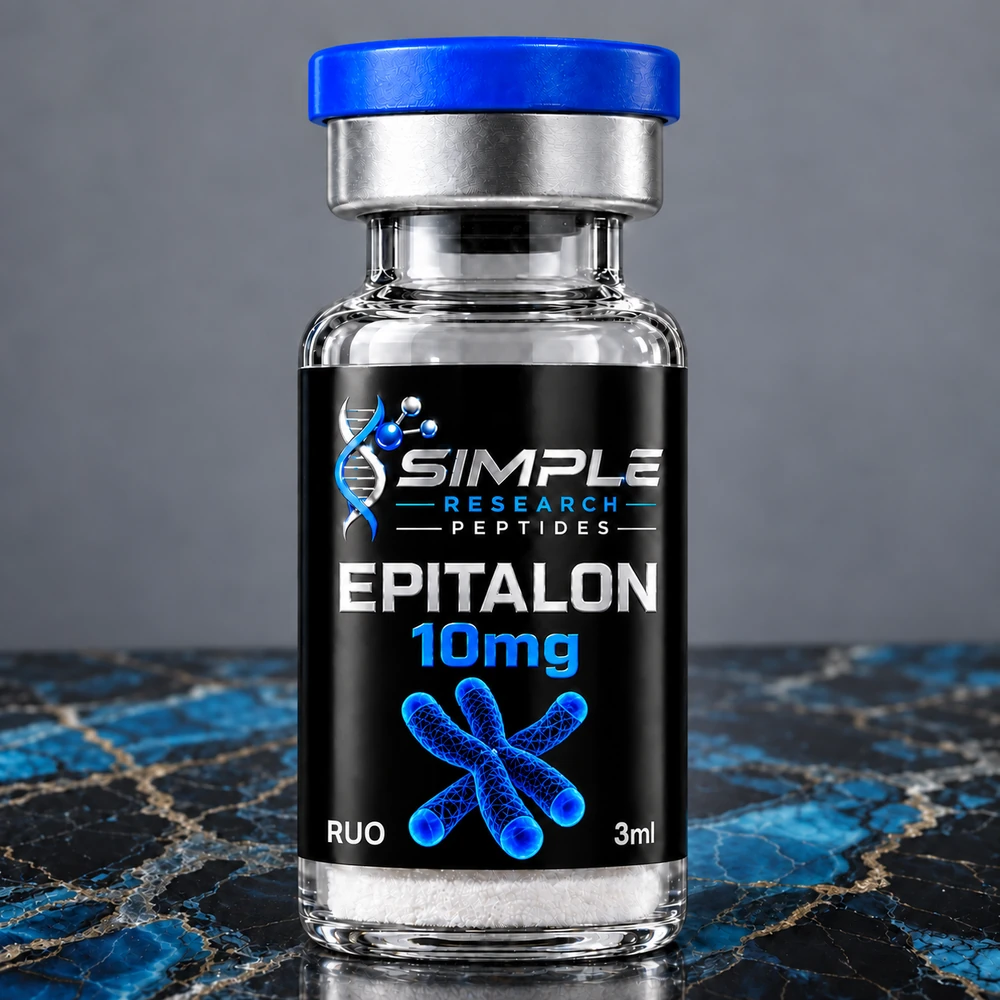
The SRP 10 mg and 40 mg listings are two strengths of the same research tetrapeptide and share this guide. Listed milligram strength is a catalog amount, not a use instruction.
Common questions
What is Epitalon?
A synthetic tetrapeptide, Ala-Glu-Asp-Gly (AEDG), also spelled Epithalon or Epithalone. It was made from the amino-acid composition of the pineal extract Epithalamin and later reported as a component of that complex (PMID 29124531; PMID 40141333).
Is Epithalon a different peptide?
No. Opened registry records treat Epitalon, Epithalon, and Epithalone as the same UNII (O65P17785G) and the same sequence. Search both spellings when matching literature or a vial label.
Is it the same as Epithalamin?
No. Epithalamin is a bovine pineal polypeptide extract. Epitalon is the synthetic tetrapeptide AEDG. Do not cite extract papers as tetrapeptide-only evidence. Do not relabel Epithalamin extract as AEDG.
What sequence and identifiers are reported?
Ala-Glu-Asp-Gly. Formula C14H22N4O9. Mass ~390.35. UNII O65P17785G. CAS 307297-39-8 (PubChem CID 219042; FDA GSRS; NCATS).
Does it lengthen telomeres?
In opened cell-culture papers, yes in some systems (PMID 12937682; PMID 15455129; PMID 40908429). Al-Dulaimi 2025 also reported ALT in two breast-cancer lines. In 11 men’s PHA-stimulated lymphocytes, length went up in some donors and down in others (PMID 31761987). In-vivo human telomere lengthening after a research vial is not shown in this set.
Does it extend lifespan?
Not in humans in any opened trial. In female SHR mice, mean lifespan did not change (PMID 14501183). Some rodent papers report longer maximum or last-decile survival, especially under disrupted light. That is not a human result. Fly lifespan is not a human result.

Does it restore melatonin?
Not established as a general fact. Djeridane 2003 found no effect in rat pineal perifusion (PMID 12809170). Khavinson 2012 found an increase in pinealocyte culture (PMID 22816096).
Is there a ClinicalTrials.gov study?
Not in the API search opened for this draft (empty studies array for epitalon / epithalon / epithalone / AEDG).
Is Epitalon FDA-approved?
No. Educational information only. Not an FDA-approved drug for human use. Investigational research compound.
Do the 10 mg and 40 mg vials need separate guides?
No. They are the same research tetrapeptide at two listed strengths. Evidence does not split by marketplace vial size. One facts page.
Does this page include human dosing?
No. There is no human dosing, reconstitution, or administration protocol on this page.
Citations used on this page
Full citations for the verified set. Each line is a paper (or registry record) actually opened for this draft. One-line findings are from those opened Europe PMC / PubChem / FDA / NCATS / ClinicalTrials / SRP records.
- Khavinson VKh, Bondarev IE, Butyugov AA. Epithalon peptide induces telomerase activity and telomere elongation in human somatic cells. Bull Exp Biol Med. 2003;135(6):590-592. doi: 10.1023/a:1025493705728. PMID 12937682. Telomerase-negative human fetal fibroblasts: catalytic-subunit expression, telomerase activity, and telomere elongation.
- Anisimov VN, Khavinson VKh, Popovich IG, Zabezhinski MA, Alimova IN, Rosenfeld SV, Zavarzina NY, Semenchenko AV, Yashin AI. Effect of Epitalon on biomarkers of aging, life span and spontaneous tumor incidence in female Swiss-derived SHR mice. Biogerontology. 2003;4(4):193-202. doi: 10.1023/a:1025114230714. PMID 14501183. Mean lifespan unchanged; maximum lifespan +12.3%; last 10% +13.3%; leukemia 6-fold lower; total tumors unchanged.
- Anisimov VN, Khavinson VK, Provinciali M, Alimova IN, Baturin DA, Popovich IG, Zabezhinski MA, Imyanitov EN, Mancini R, Franceschi C. Inhibitory effect of the peptide epitalon on the development of spontaneous mammary tumors in HER-2/neu transgenic mice. Int J Cancer. 2002;101(1):7-10. doi: 10.1002/ijc.10570. PMID 12209581. Lower mammary-tumor burden and 3.7-fold lower tumor HER-2/neu mRNA; Vilon arm worse than saline on several metrics.
- Djeridane Y, Khavinson VKh, Anisimov VN, Touitou Y. Effect of a synthetic pineal tetrapeptide (Ala-Glu-Asp-GLy) on melatonin secretion by the pineal gland of young and old rats. J Endocrinol Invest. 2003;26(3):211-215. doi: 10.1007/bf03345159. PMID 12809170. No significant melatonin effect in perifused young or old rat pineals, including under isoproterenol.
- Khavinson VKh, Linkova NS, Kvetnoy IM, Kvetnaia TV, Polyakova VO, Korf HW. Molecular cellular mechanisms of peptide regulation of melatonin synthesis in pinealocyte culture. Bull Exp Biol Med. 2012;153(2):255-258. doi: 10.1007/s10517-012-1689-5. PMID 22816096. Epithalone increased AANAT, pCREB, and melatonin in rat pinealocyte culture.
- Khavinson VK, Kopylov AT, Vaskovsky BV, Ryzhak GA, Lin’kova NS. Identification of Peptide AEDG in the Polypeptide Complex of the Pineal Gland. Bull Exp Biol Med. 2017;164(1):41-43. doi: 10.1007/s10517-017-3922-8. PMID 29124531. SRM/HPLC-MS detected AEDG among tetrapeptides of the epiphysis polypeptide complex.
- Khavinson VK, Pendina AA, Efimova OA, Tikhonov AV, Koltsova AS, Krapivin MI, Petrovskaia-Kaminskaia AV, Petrova LI, Lin’kova NS, Baranov VS. Effect of Peptide AEDG on Telomere Length and Mitotic Index of PHA-Stimulated Human Blood Lymphocytes. Bull Exp Biol Med. 2019;168(1):141-144. doi: 10.1007/s10517-019-04664-0. PMID 31761987. Telomere length changed in 7/11 men (increased in 5, decreased in 2).
- Khavinson V, Diomede F, Mironova E, Linkova N, Trofimova S, Trubiani O, Caputi S, Sinjari B. AEDG Peptide (Epitalon) Stimulates Gene Expression and Protein Synthesis during Neurogenesis: Possible Epigenetic Mechanism. Molecules. 2020;25(3):E609. doi: 10.3390/molecules25030609. PMID 32019204. PMCID PMC7037223. hGMSCs: Nestin/GAP43/β-tubulin III/doublecortin mRNA 1.6–1.8-fold; histone H1 docking proposed.
- Al-Dulaimi S, Thomas R, Matta S, Roberts T. Epitalon increases telomere length in human cell lines through telomerase upregulation or ALT activity. Biogerontology. 2025;26(5):178. doi: 10.1007/s10522-025-10315-x. PMID 40908429. PMCID PMC12411320. Independent cell-line study: telomerase route in normal cells; ALT in cancer lines.
- Yue X, Liu SL, Guo JN, Meng TG, Zhang XR, Li HX, Song CY, Wang ZB, Schatten H, Sun QY, Guo XP. Epitalon protects against post-ovulatory aging-related damage of mouse oocytes in vitro. Aging (Albany NY). 2022;14(7):3191-3202. doi: 10.18632/aging.204007. PMID 35413689. PMCID PMC9037278. Epitalon reduced ROS and aging-associated defects in cultured mouse oocytes.
- Khavinson et al., 2003, Neuro Endocrinol Lett, PMID 14647006 — chromatin activation in cultured lymphocytes, ages 76–80.
- Khavinson et al., 2004, Bull Exp Biol Med, PMID 15455129 — extra fibroblast divisions after telomere elongation.
- Vinogradova et al., 2007, Bull Exp Biol Med, PMID 18856211 — female rats; no lifespan change under standard light.
- Vinogradova et al., 2008, Bull Exp Biol Med, PMID 19110597 — male rats; mean lifespan virtually unchanged.
- Kossoy et al., 2006, In Vivo, PMID 16634527 — C3H/He mice; fewer malignant tumors/metastases.
- Anisimov et al., 2005, Vopr Onkol, PMID 15909815 — SAMP-1/SAMR-1; last-decile survival; tumor frequency unchanged with epitalon.
- Khavinson et al., 2002, Neuro Endocrinol Lett, PMID 12195242 — Campbell rats plus unsized 90% human retinal-lesion claim.
- Korkushko et al., 2007, Adv Gerontol, PMID 17969590 — mixed Epithalamin + Epitalon melatonin report in monkeys and elderly people.
- Vanhee et al., 2015, Drug Test Anal, PMID 25535022 — tetrapeptide identified in two illegal pharmaceutical preparations.
- Avolio et al., 2022, Int J Mol Sci, PMID 35408963, PMC8999041 — five Khavinson peptides including Epitalon on THP-1 inflammation markers.
- Gatta et al., 2025, Stem Cell Rev Rep, PMID 40493162, PMC12356729 — ARPE-19 high-glucose wound model.
- Araj SK, Brzezik J, Mądra-Gackowska K, Szeleszczuk Ł., 2025, Int J Mol Sci, PMID 40141333, PMC11943447 — narrative review; mechanisms uncertain; structural work limited.
- Al-Dulaimi et al. erratum, 2025, PMID 41240216 — correction notice for PMID 40908429; not used as a separate finding.
- PubChem CID 219042 (PUG REST + PUG View): C14H22N4O9; MW 390.35; InChIKey HGHOBRRUMWJWCU-FXQIFTODSA-N; synonyms Epitalon / Epithalon / Epithalone / AEDG; CAS 307297-39-8 and 64082-79-7; UNII O65P17785G. https://pubchem.ncbi.nlm.nih.gov/compound/219042
- FDA UNII / GSRS: EPITALON, UNII O65P17785G; CAS 307297-39-8; formula C14H22N4O9. https://precision.fda.gov/uniisearch/srs/unii/O65P17785G
- NCATS Inxight: same UNII; MW 390.3459; approval year unknown; not approved US/Europe; curator note on same-institute literature. https://drugs.ncats.io/drug/O65P17785G
- ClinicalTrials.gov v2 API search
epitalon OR epithalon OR epithalone OR AEDG: emptystudiesarray (opened 16 August 2026). - Simple Research Peptides. Epitalon (10 mg Vial) product page. http://simpleresearchpeptides.com/product/epitalon-10-mg-vial/ Fetched 16 August 2026. Research use only. Same compound as the 40 mg listing.
- Simple Research Peptides. Epitalon (40 mg Vial) product page. http://simpleresearchpeptides.com/product/epitalon-40-mg-vial/ Fetched 16 August 2026. Research use only. Same facts guide as the 10 mg listing.
- Simple Research Peptides. Compound Research Guides directory. http://simpleresearchpeptides.com/research-compound-directory/compound-research-guides/
Sources searched but not used as evidence: peptide-vendor / Peptidepedia pages repeating “2–3 fold telomerase,” “10–25% longer rodent life,” or “melatonin restored 100%” without a primary paper opened here; Wikipedia Epitalon page (used only as a search pointer, not as a citation); Araj 2025 MDPI HTML full text (fetch blocked; Europe PMC abstract and PMC landing page were opened instead); Al-Dulaimi 2025 PDF full text (Europe PMC landing page + abstract opened; quantitative dose tables were not copied from an unopened PDF); 2026 Frontiers in Aging gerontology-peptide review and 2026 orthopaedic-peptide review (search hits only; not used as substitutes for primary AEDG papers); Preprints (Research Square / Preprints.org) of the 2025 telomere paper (not used in place of the published article).
Educational information only. Epitalon / Epithalon is not an FDA-approved drug for human use. Investigational compound. Laboratory research use only; not for human or animal use. Last source review: 16 August 2026 (America/Indianapolis). All PMIDs above were opened on Europe PMC (abstracts; PMC IDs noted where the PMC record was opened). Product URLs, PubChem, FDA UNII, NCATS, and ClinicalTrials.gov API were fetched the same day.