Ipamorelin Research Guide
An evidence-mapped overview of ipamorelin covering compound identity, proposed receptor pathway, published studies (ipamorelin-only vs combination), laboratory considerations, and current evidence limitations.
Phase 2 ileus not significant
Research use only
Educational information only. Ipamorelin is not an FDA-approved drug for human use. Laboratory research use only; not for human or animal use. This is a standalone ipamorelin page. The CJC-1295 + ipamorelin blend guide is a separate combo page.
Quick Facts
Ipamorelin is a synthetic pentapeptide growth-hormone secretagogue first described by Raun and colleagues at Novo Nordisk as NNC 26-0161. The 1998 paper states the sequence as Aib-His-D-2-Nal-D-Phe-Lys-NH2 and identifies the compound within a series lacking the central Ala-Trp dipeptide of GHRP-1 (Raun et al., 1998, PMID 9849822).
FDA Global Substance Registration System / NCATS records for the free base use UNII Y9M3S784Z6, CAS 170851-70-4, molecular formula C38H49N9O5, and a listed molecular weight of 711.853. Synonyms on the opened GSRS/NCATS records include NNC 26-0161, AIB-HIS-D-2-NAL-D-PHE-LYS-NH2, and 2-methylalanyl-L-histidyl-3-(2-naphthyl)-D-alanyl-D-phenylalanyl-L-lysinamide. UNII availability does not imply regulatory review or approval.
What ipamorelin is
Raun et al. (1998) described ipamorelin as a pentapeptide (Aib-His-D-2-Nal-D-Phe-Lys-NH2) identified in a chemistry programme that removed the central Ala-Trp of GHRP-1. In primary rat pituitary cells it released GH with potency and efficacy similar to GHRP-6 (EC50 1.3 ± 0.4 nmol/l, Emax 85 ± 5% vs 2.2 ± 0.3 nmol/l and 100%). Antagonist profiling with GHRP and GHRH antagonists “clearly demonstrated that ipamorelin, like GHRP-6, stimulates GH release via a GHRP-like receptor.” In pentobarbital-anaesthetised rats, ED50 was 80 ± 42 nmol/kg (Emax 1545 ± 250 ng GH/ml). In conscious swine, ED50 was 2.3 ± 0.03 nmol/kg (Emax 65 ± 0.2 ng GH/ml plasma). The authors concluded that ipamorelin was “the first GHRP-receptor agonist with a selectivity for GH release similar to that displayed by GHRH” (PMID 9849822).
That 1998 paper is the identity and selectivity foundation. It predates routine use of the name GHSR-1a / GRLN-R in the ipamorelin literature. Later opened papers (Venkova 2009; Greenwood-Van Meerveld 2012; Beck 2014) call ipamorelin a ghrelin-receptor agonist or ghrelin mimetic. No paper opened for this guide reported a modern receptor-panel binding table or a crystal structure of ipamorelin on human GHSR.
| Field | Value in opened sources | Note |
|---|---|---|
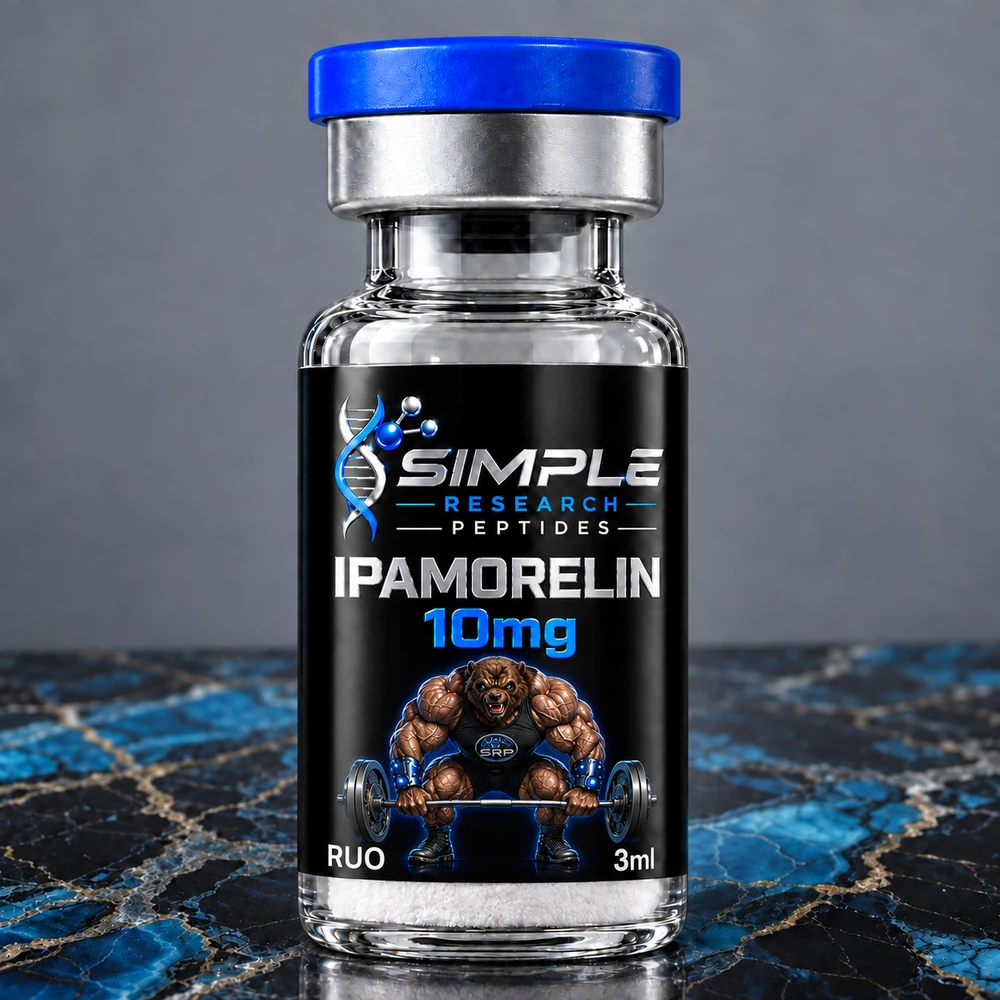
| Marketplace name | Ipamorelin | SRP 10 mg / 3 mL vial page fetched |
| Development code | NNC 26-0161 | Raun 1998; Johansen 1998 Xenobiotica; SRP product page; FDA UNII |
| Sequence | Aib-His-D-2-Nal-D-Phe-Lys-NH2 | Raun 1998; GSRS. Aib = α-aminoisobutyric acid; D-2-Nal = D-β-(2-naphthyl)alanine |
| Length | 5 residues | Not a GHRH analogue and not CJC-1295 |
| Originator | Novo Nordisk A/S | NCATS record |
| Approval | None identified | NCATS “Approval Year: Unknown”; no finished-drug approval in opened sources |
| Human evidence | IV PK/PD; Phase 2 POI | Gobburu 1999; Beck 2014 (NCT00672074) — efficacy not shown (p = 0.15) |
What opened sources actually state
Raun et al. (1998) give Aib-His-D-2-Nal-D-Phe-Lys-NH2. FDA GSRS / NCATS list the same sequence as AIB-HIS-D-2-NAL-D-PHE-LYS-NH2 and the systematic name 2-methylalanyl-L-histidyl-3-(2-naphthyl)-D-alanyl-D-phenylalanyl-L-lysinamide.
What those sources do not provide: a supplier-vial certificate, a counter-ion specification for the SRP product, or proof that a given research-market lot matches Novo Nordisk clinical-development material. Sequence confirmation remains a laboratory identity step.
Ankersen et al. (1998) described smaller peptidomimetic analogues derived from ipamorelin (NNC 26-0235, NNC 26-0323). Those analogues are not ipamorelin (PMID 9733495).
Only as far as sources support
Each item below is tagged by what was actually studied. Ipamorelin-only means data on ipamorelin or NNC 26-0161. Proposed means class nomenclature, not an ipamorelin binding table. Not shown means the experiment was not in a paper opened here.
GHRP-like receptor, GH release
In rat pituitary cells, GHRP and GHRH antagonists showed ipamorelin acts via a GHRP-like receptor, not as a GHRH-receptor ligand. GH release potency/efficacy was similar to GHRP-6 in cells, anaesthetised rats, and conscious swine.
Raun et al., 1998, PMID 9849822.
Selectivity vs ACTH/cortisol in swine
In swine, none of the secretagogues tested (including ipamorelin) affected FSH, LH, PRL, or TSH. GHRP-6 and GHRP-2 raised ACTH and cortisol. Ipamorelin did not raise ACTH or cortisol to levels significantly different from GHRH, even at doses more than 200-fold higher than the ED50 for GH release. This is a swine hormone-output finding, not a human multi-hormone panel and not a broad off-target binding screen.
Raun et al., 1998, PMID 9849822.
Human GH pulse after IV infusion
In healthy men, five 15-minute IV infusion rates (4.21–140.45 nmol/kg; eight subjects per level) produced dose-proportional PK: terminal half-life 2 hours, clearance 0.078 L/h/kg, Vss 0.22 L/kg. A single GH-release episode peaked at 0.67 hours and declined to negligible GH at all doses. Modelled SC50 214 nmol/L; maximal GH production rate 694 mIU/L/h. The opened abstract does not report cortisol, ACTH, or prolactin in those volunteers.
Gobburu et al., 1999, PMID 10496658.
Ghrelin-receptor language in later GI papers
Venkova et al. (2009) call ipamorelin “a selective growth hormone secretagogue and agonist of the ghrelin receptor.” Greenwood-Van Meerveld et al. (2012) call it “a synthetic peptidomimetic that acts on the ghrelin receptor” and, citing Raun, “selectively stimulates GRLN-R without significantly affecting plasma adrenocorticotropic hormone and cortisol levels.” Beck et al. (2014) call it a “ghrelin-receptor agonist” / “Ghrelin mimetic.” Those are later nomenclatural assignments of the same GHRP-receptor pathway, not new binding isotherms opened here.
Later GI papers treat GRLN-R as the former GHRP / growth-hormone secretagogue receptor. That is class nomenclature, not an ipamorelin Ki table.
No human GHSR binding table
A human GHSR-1a binding-affinity table or co-structure for ipamorelin was not in the papers opened here. Intracellular cascade details (PLC / IP3 / DAG / Ca2+) measured with ipamorelin as the test article were also not in those papers. Marketing pages often paste generic GHSR Gq/11 language; that cascade was not in the opened set.
No CJC-1295 + ipamorelin combo experiment
Synergistic GH release from a CJC-1295 + ipamorelin combination experiment was not found. No opened paper in this review tested that pair. The existing SRP blend guide is a separate combo page and is not a substitute standalone ipamorelin evidence base.
Where the literature actually sits
Label every cluster. Ipamorelin-only means the test article was ipamorelin (or NNC 26-0161). Combo would mean a paper that administered ipamorelin plus another secretagogue or GHRH analogue together. Not found means this review did not open such a paper.
Discovery / PK
Rat pituitary cells, anaesthetised rats, conscious swine: GH release and swine ACTH/cortisol selectivity (Raun 1998). Male rat IV / nasal PK: clearance ~5-fold lower than GHRP-6; mainly urinary excretion; ~20% estimated intranasal bioavailability (Johansen 1998). Healthy-man IV PK/PD: t½ 2 h; single GH episode peaking at 0.67 h (Gobburu 1999). Oral GH rise in dogs at 2.7 mg/kg in a chemistry paper that otherwise studies smaller analogues (Ankersen 1998).
Rodent bone / body weight / pituitary
Adult female rats, 15 days: dose-dependent longitudinal bone growth and body-weight gain; total IGF-I, IGFBPs, and serum bone-turnover markers unchanged (Johansen 1999). Young adult female rats, 12 weeks osmotic minipump: ipamorelin and GHRP-6 (separate arms) increased BMC via larger bone dimensions; volumetric BMD unchanged (Svensson 2000). 8-month-old female rats, 3 months: ipamorelin counteracted methylprednisolone-induced loss of calf-muscle tetanic tension and periosteal bone formation (Andersen 2001). Young female rats, 21 days: somatotroph ultrastructure unchanged; secretion-granule volume density increased (Jiménez-Reina 2002).
Rodent GI / postoperative ileus
Male rats after laparotomy + intestinal manipulation: single IV ipamorelin shortened time to first bowel movement; repetitive dosing increased fecal output, food intake, and body-weight gain over 48 h (Venkova 2009). Same model, upper GI: IV ipamorelin accelerated gastric emptying and small-intestinal transit; 1 µM ipamorelin or ghrelin normalized ACh- and EFS-evoked fundic contractility in vitro (Greenwood-Van Meerveld 2012).
Human clinical
Phase 2, multicenter, double-blind, placebo-controlled proof-of-concept in adults after small/large bowel resection (NCT00672074). n = 117 enrolled; 114 safety / modified ITT. Median time to first tolerated solid meal 25.3 h (ipamorelin) vs 32.6 h (placebo), p = 0.15. Authors: well tolerated; no significant differences on key or secondary efficacy analyses (Beck et al., 2014).
CJC-1295 + ipamorelin combination
Searches and the opened primary set did not yield a peer-reviewed experiment that administered CJC-1295 (DAC or no-DAC) together with ipamorelin and reported a combination-specific result. The existing SRP blend guide is a separate combo page and is not a substitute standalone ipamorelin evidence base. Class-level GHRH + ghrelin synergy papers must not be relabeled as this pair.
What was studied, in what system
Read the “compound actually studied” column first. Combination claims require a paper that actually tested both agents. No opened paper in this review tested a CJC-1295 + ipamorelin combination.
| Domain | Compound actually studied | System | Status | Source |
|---|---|---|---|---|
| Sequence / GH release / swine selectivity | Ipamorelin (Aib-His-D-2-Nal-D-Phe-Lys-NH2) | Rat pituitary cells; anaesthetised rats; conscious swine | Ipamorelin-only | PMID 9849822 |
| Rat PK / nasal absorption | Ipamorelin (NNC 26-0161) vs GHRP-2, GHRP-6, other NNC peptides | Male rat; IV and intranasal | Ipamorelin-only | PMID 9879640 |
| Analogue chemistry; oral GH | Ipamorelin and derived peptidomimetics (NNC 26-0235, NNC 26-0323) | Rat pituitary cells; anaesthetised rats; swine; dogs (oral) | Ipamorelin-only (plus analogues) | PMID 9733495 |
| Human PK/PD | Ipamorelin IV infusion | Healthy men; 5 dose levels; 8 per level | Ipamorelin-only | PMID 10496658 |
| Longitudinal bone growth | Ipamorelin 0, 18, 90, 450 µg/day | Adult female rats; 15 days; s.c. t.i.d. | Ipamorelin-only | PMID 10373343 |
| Bone mineral content | Ipamorelin 0.5 mg/kg/day (separate GHRP-6 and GH arms) | 13-week female Sprague-Dawley rats; 12 weeks minipump | Ipamorelin-only (parallel arms, not a combo) | PMID 10828840 |
| Glucocorticoid bone / muscle | Ipamorelin 100 µg/kg t.i.d. ± methylprednisolone | 8-month female rats; 3 months | Ipamorelin-only (± GC, not a GHRH combo) | PMID 11735244 |
| Somatotroph histology | Ipamorelin 21 days vs GHRH vs saline | Young female rats; then pituitary cultures | Ipamorelin-only | PMID 12168778 |
| Rodent POI, lower GI | Ipamorelin 0.01–1 mg/kg IV | Male rats; laparotomy + intestinal manipulation | Ipamorelin-only | PMID 19289567 |
| Rodent POI, gastric emptying | Ipamorelin 0.014–0.14 µmol/kg IV; 1 µM in vitro | Male Sprague-Dawley rats; fundic strips | Ipamorelin-only | PMID 27186127 |
| Human postoperative ileus | Ipamorelin 0.03 mg/kg IV b.i.d. vs placebo | Adults after bowel resection; Phase 2; n=114 | Ipamorelin-only; efficacy not shown | PMID 25331030; NCT00672074 |
| Registry identity | Ipamorelin free base | FDA GSRS / NCATS | Identity only | UNII Y9M3S784Z6; CAS 170851-70-4 |
| CJC-1295 + ipamorelin combination | — | — | Combo Not found | No opened combo paper |
How the record accumulated
Identity, rat PK, analogue chemistry
Raun et al.: pentapeptide sequence; GHRP-like receptor; GH release in cells, rats, swine; no ACTH/cortisol rise in swine vs GHRH even at >200× GH ED50. PMID 9849822. Johansen et al.: male-rat PK; clearance 5-fold lower than GHRP-6; mainly urinary; ~20% nasal bioavailability. PMID 9879640. Ankersen et al.: smaller analogues from ipamorelin; ipamorelin 2.7 mg/kg oral raised basal GH >10-fold in dogs. PMID 9733495.
Human IV PK/PD; rat bone growth
Gobburu et al.: healthy men; t½ 2 h; single GH episode, peak 0.67 h. PMID 10496658. Johansen et al.: adult female rats; dose-dependent tibial longitudinal growth and body-weight gain; circulating IGF-I and bone-turnover markers unchanged. PMID 10373343.
Bone geometry; glucocorticoid model; somatotrophs
Svensson et al.: 12-week minipump in young adult female rats; BMC up because bones grew larger; volumetric BMD unchanged. PMID 10828840. Andersen et al.: 3-month adult female rats; ipamorelin counteracted methylprednisolone effects on tetanic tension and periosteal bone formation. PMID 11735244. Jiménez-Reina et al.: 21-day young female rats; granule volume density up; later in-vitro secretagogue challenge increased somatotroph percentage and GH content only after ipamorelin pretreatment. PMID 12168778.
Rodent postoperative ileus
Venkova et al.: rat POI; single dose shortened time to first stool; repetitive dosing increased fecal output, food intake, and weight gain. PMID 19289567. Greenwood-Van Meerveld et al.: same model; accelerated gastric emptying and small-bowel transit; fundic contractility restored in vitro. PMID 27186127.
Human Phase 2 ileus trial, negative on efficacy
Beck et al. / Ipamorelin 201 Study Group: NCT00672074; well tolerated; primary meal-tolerance endpoint not significant (p = 0.15). PMID 25331030.
CJC-1295 + ipamorelin — not found
No opened dated paper in this set reports a CJC-1295 + ipamorelin co-administration experiment. Combo claims stay on the separate blend page as related material only.
What is not established
These are gaps in the opened record. Treating any of them as settled is incorrect.
No approved therapeutic use
Ipamorelin is not an FDA-approved finished drug in the sources opened here (NCATS approval year unknown; SRP and ClinicalTrials records are investigational / research-use). Beck 2014 did not establish efficacy for postoperative ileus.
Selectivity is a swine hormone-output finding
“Does not raise cortisol / ACTH / prolactin” is documented in swine by Raun 1998 (ACTH/cortisol vs GHRH; PRL/FSH/LH/TSH unchanged for the class). Gobburu 1999 modelled GH in healthy men and, in the opened abstract, did not report a cortisol/prolactin/ACTH panel. Do not cite Gobburu as a human “clean endocrine profile” trial.
No GHSR binding table opened
Raun demonstrated a GHRP-like receptor by antagonist pharmacology. Later papers use ghrelin-receptor / GRLN-R language. A Ki, Bmax, or structure for ipamorelin on human GHSR-1a was not in the papers opened here.
No human fat loss, muscle, sleep, or “anti-aging”
Bone-growth, BMC, and glucocorticoid-muscle findings are rat studies (Johansen 1999; Svensson 2000; Andersen 2001). No opened human trial measured body composition, sleep, injury recovery, or “anti-aging” endpoints.
Human POI efficacy was not demonstrated
The only opened efficacy-style human trial (Beck 2014) did not meet its key or secondary efficacy analyses (p = 0.15). Rodent POI prokinetic data (Venkova 2009; Greenwood-Van Meerveld 2012) did not translate into a positive Phase 2 result in that bowel-resection study.
No opened CJC-1295 + ipamorelin combination study
Synergy of GHRH-receptor and ghrelin-receptor pathways is a class rationale, not a finding from a paper that tested this pair. Do not treat the SRP blend page, supplier “stack” articles, or GHRH + ghrelin physiology papers as ipamorelin-only evidence.
Human PK is IV infusion, not a research-vial curve
Gobburu’s 2-hour half-life and 0.67-hour GH peak are from 15-minute IV infusions in healthy men. That is not a PK study of a 10 mg lyophilized research vial or of a subcutaneous research protocol.
Chronic human safety is not established
Beck 2014 reported short-term hospital AE rates after up to 7 days of IV dosing around bowel surgery. That is not a long-term outpatient safety dataset. Johansen 1999 explicitly said any place in treating children with growth retardation “requires demonstration in future clinical studies.”
IGF-I elevation is not a consistent opened finding
Johansen 1999 reported no change in total IGF-I or IGFBPs after 15 days in adult female rats despite increased longitudinal growth and body weight. Do not assume ipamorelin “raises IGF-1” as a settled, cross-species fact from this set. No opened human IGF-I time course.
| Popular claim | Status after this review |
|---|---|
| “Selective GHSR-1a agonist with a published human binding Ki” | Receptor class is supported (GHRP-like receptor → later called ghrelin / GRLN-R). A human GHSR binding table was not in papers opened here. |
| “Does not raise cortisol or prolactin in humans” | Documented in swine (Raun 1998). Not shown in the opened Gobburu abstract. |
| “Raises IGF-1” as a general fact | Johansen 1999: total IGF-I unchanged in that 15-day rat protocol. No opened human IGF-I time course. |
| Fat loss / muscle gain / sleep / “anti-aging” / tendon repair | Not found in opened papers. |
| “Works for postoperative ileus” | Rodent POI signals exist. Human Phase 2 (Beck 2014) was not significant on efficacy (p = 0.15). |
| “Synergistic with CJC-1295” as a published combo result | Not found. No opened paper tested that pair. Combo page is related material only. |
| “2-hour half-life after typical research-vial use” | Gobburu: 2 h after IV infusion in healthy men. Not a SC vial PK study. |
| “Oral / nasal peptide for humans” | Rat nasal ~20% (Johansen 1998); dog oral GH rise at 2.7 mg/kg (Ankersen 1998). Not a human oral/nasal product study. |
| Marketplace vial = Novo Nordisk clinical lot | Not established. Sequence must be confirmed analytically. |
Primary papers in this map
Every PMID below is from the verified set used to build this page. Combination papers are labeled combo only when a paper actually tested both agents. No opened paper tested a CJC-1295 + ipamorelin combination.
Raun et al., 1998 — Eur J Endocrinol
Pentapeptide Aib-His-D-2-Nal-D-Phe-Lys-NH2; GHRP-like receptor; GH release in rat cells, rats, and swine; no ACTH/cortisol rise vs GHRH in swine even at >200× GH ED50. Swine hormone-output finding, not a human panel. PMID 9849822.
Johansen, Hansen, Andersen, Johansen, 1998 — Xenobiotica
Male rat; IV clearance ~5-fold lower than GHRP-6; mainly urinary excretion; ~20% estimated nasal bioavailability; 60–80% recovered intact in bile + urine. PMID 9879640.
Gobburu, Agersø, Jusko, Ynddal, 1999 — Pharm Res
Healthy men; IV infusions 4.21–140.45 nmol/kg over 15 min; t½ 2 h; single GH episode peaking at 0.67 h; SC50 214 nmol/L. Opened abstract does not report cortisol, ACTH, or prolactin. PMID 10496658.
Johansen et al., 1999 — Growth Horm IGF Res
Adult female rats; 15 days; dose-dependent tibial longitudinal growth (42 → 52 µm/day) and body-weight gain; total IGF-I / IGFBPs / bone-turnover markers unchanged. PMID 10373343.
Svensson et al., 2000 — J Endocrinol
Young adult female rats; 12-week minipump; ipamorelin (and separate GHRP-6 / GH arms) increased BMC via increased bone size; volumetric BMD unchanged. Parallel arms, not a combo. PMID 10828840.
Andersen et al., 2001 — Growth Horm IGF Res
8-month female rats; 3 months; ipamorelin counteracted methylprednisolone-induced decreases in calf tetanic tension and periosteal bone formation (four-fold BFR vs GC alone). PMID 11735244.
Jiménez-Reina, Cañete, de la Torre, Bernal, 2002 — Histol Histopathol
Young female rats; 21 days; granule volume density increased; later in-vitro GHS/GHRH challenge raised somatotroph percentage and intracellular GH only in the ipamorelin-pretreated group. PMID 12168778.
Venkova, Mann, Nelson, Greenwood-Van Meerveld, 2009 — J Pharmacol Exp Ther
Rat laparotomy + intestinal manipulation; single IV dose shortened time to first bowel movement; repetitive dosing increased fecal output, food intake, and weight gain. PMID 19289567.
Greenwood-Van Meerveld, Tyler, Mohammadi, Pietra, 2012 — J Exp Pharmacol
Same POI model; IV ipamorelin accelerated gastric emptying and small-bowel transit; 1 µM ipamorelin or ghrelin normalized ACh- and EFS-evoked fundic contractility. Full text opened. PMID 27186127. PMCID PMC4863553.
Beck, Sweeney, McCarter, Ipamorelin 201 Study Group, 2014 — Int J Colorectal Dis
Bowel-resection inpatients; 0.03 mg/kg IV b.i.d.; n=114; time to tolerated meal 25.3 vs 32.6 h, p=0.15; well tolerated; no significant key or secondary efficacy differences. PMID 25331030. NCT00672074.
Ankersen et al., 1998 — J Med Chem
Smaller peptidomimetic analogues derived from ipamorelin (NNC 26-0235, NNC 26-0323). Those analogues are not ipamorelin. Ipamorelin 2.7 mg/kg oral raised basal GH >10-fold in dogs. PMID 9733495.
CJC-1295 + ipamorelin combination
No opened paper in this review administered CJC-1295 (DAC or no-DAC) together with ipamorelin and reported a combination-specific result. The existing SRP blend guide is a separate combo page and is related material only.
Research-only caution
Ipamorelin is an investigational research compound. It is not an FDA-approved drug for human use. This page is educational. It does not provide dosing, reconstitution, administration, or any human-use instructions.
SRP material is for laboratory research only. It is not for human or animal use, consumption, administration, diagnosis, treatment, or therapeutic application.
Laboratory identity is the first practical issue. Opened analytical/registry records treat ipamorelin as the pentapeptide amide Aib-His-D-2-Nal-D-Phe-Lys-NH2 (UNII Y9M3S784Z6; CAS 170851-70-4; ~712 Da free base). A method or protocol written for GHRP-2, GHRP-6, ghrelin, CJC-1295, or a blend is not automatically valid for this monomer.
Biological inference has the same problem. Swine ACTH/cortisol selectivity, rat bone-growth and POI findings, and a negative human ileus trial are not interchangeable with marketplace claims about fat loss, sleep, or “GH stacks.” The 2014 Phase 2 study is a reminder that rodent GI prokinesis did not become a positive human efficacy result in that protocol.
Independently sourced research peptides are not established as equivalent to Novo Nordisk or Helsinn clinical-development lots. Confirm sequence, C-terminal amidation, counter-ion, purity, and identity before treating a vial as the literature compound.
Common questions
What is ipamorelin?
A synthetic pentapeptide, Aib-His-D-2-Nal-D-Phe-Lys-NH2 (NNC 26-0161), first characterized as a selective GHRP-receptor GH secretagogue (Raun et al., 1998, PMID 9849822). Later papers call it a ghrelin-receptor / GRLN-R agonist.
Is it the same as CJC-1295 or a CJC-1295 blend?
No. CJC-1295 is a GHRH-receptor analogue (DAC or no-DAC). Ipamorelin is a GHRP / ghrelin-receptor-class pentapeptide. The existing SRP blend guide is a separate combo page. This review found no opened paper that tested the combination.
What sequence is reported?
Aib-His-D-2-Nal-D-Phe-Lys-NH2 (Raun 1998; FDA GSRS / NCATS). Also known as NNC 26-0161. UNII Y9M3S784Z6; CAS 170851-70-4.
Did human studies show GH release?
Yes, in one opened PK/PD study: Gobburu et al. (1999) observed a single GH-release episode peaking at 0.67 hours after IV infusion in healthy men (PMID 10496658). That paper is PK/PD, not an efficacy trial. The opened abstract does not report a cortisol/ACTH/prolactin panel.
Did the postoperative-ileus trial work?
Not on the published efficacy analyses. Beck et al. (2014): well tolerated; median time to first tolerated meal 25.3 vs 32.6 hours, p=0.15; no significant key or secondary efficacy differences (PMID 25331030).
Does it raise IGF-1?
Not established as a general fact from this set. Johansen 1999 reported no change in total IGF-I or IGFBPs in adult female rats after 15 days, despite increased longitudinal growth (PMID 10373343). No opened human IGF-I time course.
Does it avoid cortisol and prolactin?
In swine, Raun 1998 found no ACTH/cortisol rise vs GHRH and no effect on PRL/FSH/LH/TSH. A matching human multi-hormone panel was not in the opened Gobburu abstract. Swine ACTH/cortisol selectivity is not a human panel.
Is there a published CJC-1295 + ipamorelin study?
Not in this review. Combination-specific effects require a paper that actually tested both agents. The blend guide is related combo material only.
Is ipamorelin FDA-approved?
No. Educational information only. Not an FDA-approved drug for human use. Investigational research compound.
Does this page include human dosing?
No. There is no human dosing, reconstitution, or administration protocol on this page.
Citations used on this page
Full citations for the verified set. Each line is a paper (or registry record) actually opened for this draft. One-line findings are from those opened abstracts or, for Greenwood-Van Meerveld 2012, the opened PMC full text.
- Raun K, Hansen BS, Johansen NL, Thøgersen H, Madsen K, Ankersen M, Andersen PH. Ipamorelin, the first selective growth hormone secretagogue. Eur J Endocrinol. 1998;139(5):552-561. doi: 10.1530/eje.0.1390552. PMID 9849822. Sequence Aib-His-D-2-Nal-D-Phe-Lys-NH2; GHRP-like receptor GH release in rat cells, rats, and swine; no ACTH/cortisol rise vs GHRH in swine even at >200× GH ED50.
- Johansen PB, Hansen KT, Andersen JV, Johansen NL. Pharmacokinetic evaluation of ipamorelin and other peptidyl growth hormone secretagogues with emphasis on nasal absorption. Xenobiotica. 1998;28(11):1083-1092. doi: 10.1080/004982598238976. PMID 9879640. Male rat: IV clearance ~5-fold lower than GHRP-6; mainly urinary excretion; ~20% estimated nasal bioavailability; 60–80% recovered as intact peptide.
- Gobburu JVS, Agersø H, Jusko WJ, Ynddal L. Pharmacokinetic-pharmacodynamic modeling of ipamorelin, a growth hormone releasing peptide, in human volunteers. Pharm Res. 1999;16(9):1412-1416. doi: 10.1023/a:1018955126402. PMID 10496658. Healthy men, IV infusion: t½ 2 h; single GH episode peaking at 0.67 h; SC50 214 nmol/L.
- Johansen PB, Nowak J, Skjaerbaek C, Flyvbjerg A, Andreassen TT, Wilken M, Ørskov H. Ipamorelin, a new growth-hormone-releasing peptide, induces longitudinal bone growth in rats. Growth Horm IGF Res. 1999;9(2):106-113. doi: 10.1054/ghir.1999.9998. PMID 10373343. Adult female rats, 15 days: dose-dependent tibial longitudinal growth and body-weight gain; total IGF-I and bone-turnover markers unchanged.
- Svensson J, Lall S, Dickson SL, Bengtsson BA, Rømer J, Ahnfelt-Rønne I, Ohlsson C, Jansson JO. The GH secretagogues ipamorelin and GH-releasing peptide-6 increase bone mineral content in adult female rats. J Endocrinol. 2000;165(3):569-577. doi: 10.1677/joe.0.1650569. PMID 10828840. 12-week minipump: BMC rose because bones grew larger; volumetric BMD unchanged.
- Andersen NB, Malmlöf K, Johansen PB, Andreassen TT, Ørtoft G, Oxlund H. The growth hormone secretagogue ipamorelin counteracts glucocorticoid-induced decrease in bone formation of adult rats. Growth Horm IGF Res. 2001;11(5):266-272. doi: 10.1054/ghir.2001.0239. PMID 11735244. 8-month female rats, 3 months: ipamorelin counteracted methylprednisolone-induced loss of tetanic tension and periosteal bone formation.
- Jiménez-Reina L, Cañete R, de la Torre MJ, Bernal G. Influence of chronic treatment with the growth hormone secretagogue Ipamorelin, in young female rats: somatotroph response in vitro. Histol Histopathol. 2002;17(3):707-714. doi: 10.14670/hh-17.707. PMID 12168778. 21-day pretreatment increased granule volume density; later in-vitro GHS/GHRH challenge raised somatotroph percentage and GH content only in the ipamorelin group.
- Venkova K, Mann W, Nelson R, Greenwood-Van Meerveld B. Efficacy of ipamorelin, a novel ghrelin mimetic, in a rodent model of postoperative ileus. J Pharmacol Exp Ther. 2009;329(3):1110-1116. doi: 10.1124/jpet.108.149211. PMID 19289567. Rat POI: single IV dose shortened time to first bowel movement; repetitive dosing increased fecal output, food intake, and weight gain.
- Greenwood-Van Meerveld B, Tyler K, Mohammadi E, Pietra C. Efficacy of ipamorelin, a ghrelin mimetic, on gastric dysmotility in a rodent model of postoperative ileus. J Exp Pharmacol. 2012;4:149-155. doi: 10.2147/JEP.S35396. PMID 27186127. PMCID PMC4863553. Rat POI: accelerated gastric emptying and small-bowel transit; 1 µM ipamorelin or ghrelin normalized fundic ACh/EFS contractility.
- Beck DE, Sweeney WB, McCarter MD; Ipamorelin 201 Study Group. Prospective, randomized, controlled, proof-of-concept study of the Ghrelin mimetic ipamorelin for the management of postoperative ileus in bowel resection patients. Int J Colorectal Dis. 2014;29(12):1527-1534. doi: 10.1007/s00384-014-2030-8. PMID 25331030. Human Phase 2 (NCT00672074): well tolerated; time to tolerated meal 25.3 vs 32.6 h (p=0.15); no significant efficacy differences.
- Ankersen M et al. J Med Chem. 1998. PMID 9733495. Analogue chemistry / dog oral GH. Used in the timeline and snapshot; analogues NNC 26-0235 and NNC 26-0323 are not ipamorelin.
- FDA UNII / GSRS: Ipamorelin, UNII Y9M3S784Z6; CAS 170851-70-4; formula C38H49N9O5; sequence AIB-HIS-D-2-NAL-D-PHE-LYS-NH2. FDA GSRS UNII Y9M3S784Z6.
- NCATS Inxight: same UNII; MW 711.853; originator Novo Nordisk A/S; approval year unknown. NCATS Y9M3S784Z6.
- ClinicalTrials.gov NCT00672074 (Helsinn; Phase 2 POI; n=117; completed). Supports Beck 2014; no efficacy numbers beyond the published paper were taken from this registry page.
Educational information only. Ipamorelin is not an FDA-approved drug for human use. Investigational compound. Laboratory research use only; not for human or animal use.