CJC-1295 No DAC Research Guide
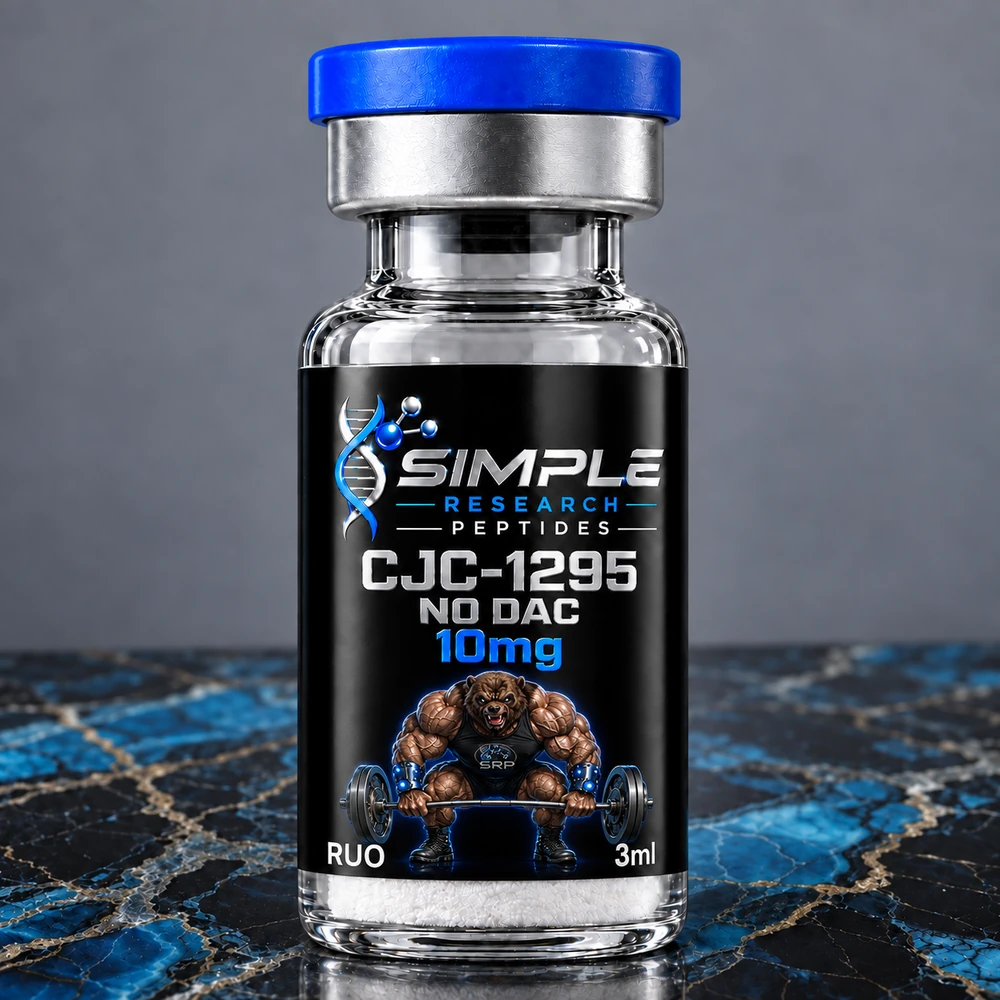
Marketplace “CJC-1295 No DAC” is typically a catalog name for tetrasubstituted GHRH(1-29) amide / Modified GRF 1-29. It is not true CJC-1295 with DAC, and it is not tesamorelin. Indexed “CJC-1295” papers almost always study the albumin-binding DAC construct.
Not the DAC clinical molecule
Research use only
Educational information only. CJC-1295 (with or without DAC) is not an FDA-approved drug. Laboratory research use only; not for human or animal use.
Quick Facts
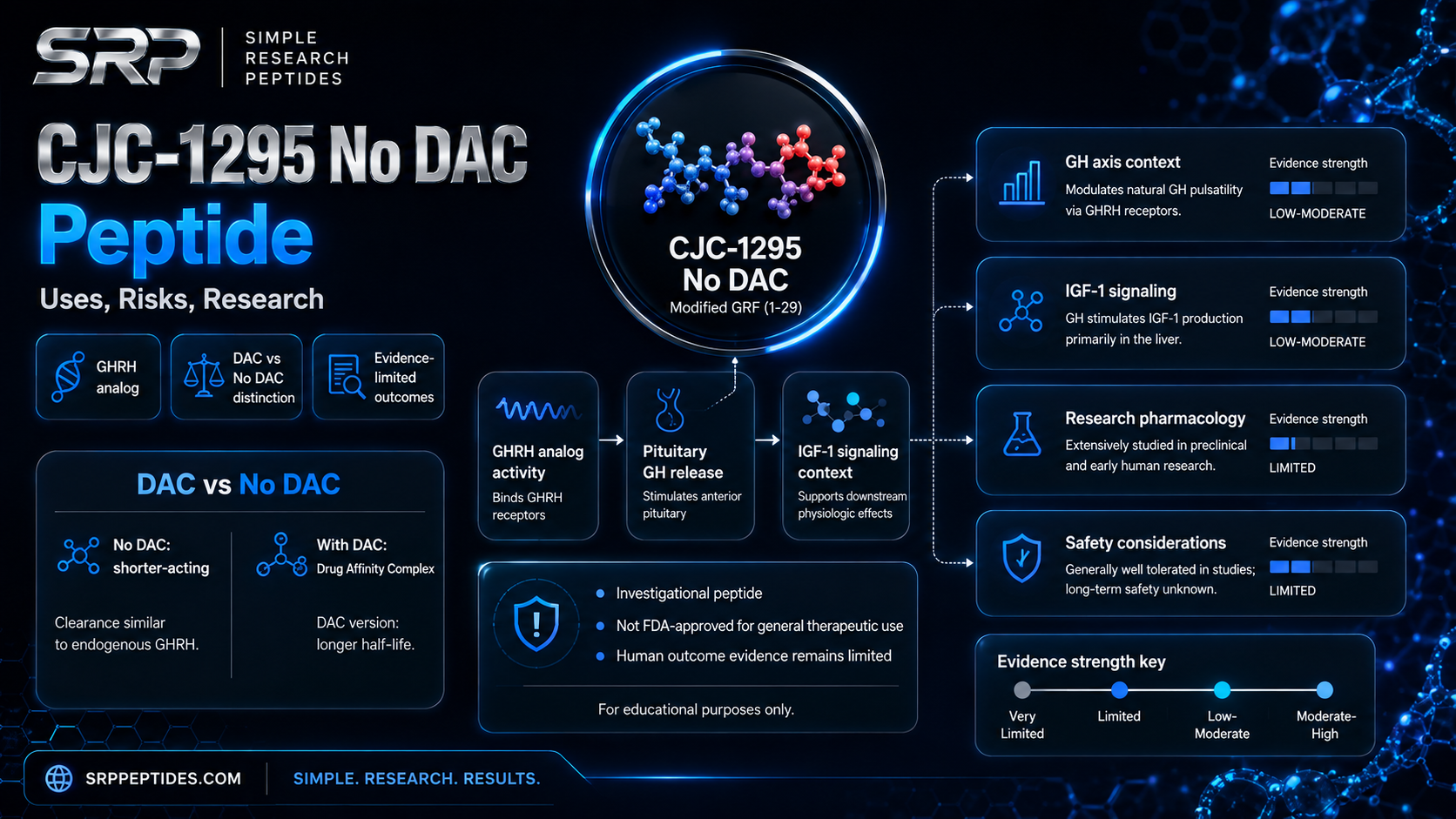
“CJC-1295 No DAC” is a marketplace name, not a separate ConjuChem clinical product with its own human trial program. In research catalogs it usually means a tetrasubstituted analogue of human GHRH(1-29) amide — also called Modified GRF 1-29 — without the C-terminal Drug Affinity Complex (DAC) that defines true CJC-1295.
True CJC-1295 in the peer-reviewed literature is the long-acting molecule: the same tetrasubstituted GHRH(1-29) core plus a C-terminal lysine bearing an Nε-3-maleimidopropionamide group that covalently binds serum albumin after administration (Jetté et al., 2005, PMID 15817669). That DAC construct is what Teichman, Ionescu, Alba, and Sackmann-Sala actually studied.
Tesamorelin is a third, different GHRH analogue: the full 44-residue human GRF sequence with an N-terminal hexenoyl group. An FDA-approved tesamorelin finished drug exists for a narrow HIV-lipodystrophy indication. It is not Modified GRF 1-29 and is not CJC-1295.
What the marketplace name usually means
Jetté and colleagues identified CJC-1295 as the best of three maleimido hGRF(1-29) derivatives after ex vivo conjugation to human serum albumin, in vitro GH release from cultured rat anterior pituitary cells, and subcutaneous dosing in Sprague-Dawley rats (PMID 15817669). Teichman et al. (2006) then used that DAC-GRF construct in healthy adults (PMID 16352683).
A research report that says only “CJC-1295” should be read as the DAC molecule unless the paper explicitly tests a no-DAC peptide and states the sequence. Indexed papers that use the name “CJC-1295” almost always study the albumin-binding DAC construct. Human exposure data for marketplace no-DAC vials were not identified in the papers opened for this guide.
| Identity | What published sources actually describe | DAC / albumin handle | Typical literature role |
|---|---|---|---|
| Native GHRH / GRF | Human GRF(1-44)-NH2 and shorter C-terminal forms, including GRF(1-29)-NH2 | None | Endogenous / first-generation research ligand |
| Sermorelin | Unmodified GHRH(1-29) amide | None | Short fragment that retains GH-releasing activity in fragment studies |
| Modified GRF 1-29 (“CJC-1295 No DAC”) | Catalog name for the tetrasubstituted GHRH(1-29) amide without the maleimide-lysine | Absent | Marketplace / research-chemical synonym; not the molecule in the ConjuChem human papers |
| CJC-1295 (true / with DAC) | Jetté et al.: a tetrasubstituted form of hGRF(1-29) with an added Nε-3-maleimidopropionamide derivative of lysine at the C terminus | Present — binds albumin Cys34 | The compound in the 2005–2009 ConjuChem / academic papers |
| Tesamorelin | DailyMed: 44-amino-acid human GRF plus a hexenoyl moiety on the N-terminal tyrosine | None (different modification) | Approved finished-drug analogue; different length and chemistry |
Modifications stated in opened sources
Frohman et al. (1989) give the native human GRH(1-44)-NH2 N-terminus as Tyr-Ala-Asp-Ala-Ile-Phe-Thr-Asn-Ser-Tyr-Arg-Lys-Val-Leu-Gly-Gln-Leu-Ser-Ala-Arg-Lys-Leu-Leu-Gln-Asp-Ile-Met-Ser-Arg-… and state that full biological activity of GRH “resides within the first 29 amino acids,” citing earlier fragment work (PMID 2565342).
True CJC-1295 (DAC) — Jetté et al. (2005), as retrieved from the paper text:
- Backbone: tetrasubstituted hGRF(1-29) amide.
- Substitutions named in that paper: D-Ala at position 2, Gln at position 8 (to reduce asparagine rearrangement / deamidation), Ala at position 15 (to enhance bioactivity), Leu at position 27 (to prevent methionine oxidation).
- C-terminus: MPA-Lys30 (Nε-3-maleimidopropionamide-lysine). Jetté’s designation: MPA-Lys30, D-Ala2, Gln8, Ala15, Leu27-GRF amide (CJC-1295).
What “No DAC” would be, if the catalog name is chemically honest: the same four substitutions without MPA-Lys30. That inference comes from subtracting the DAC element Jetté defined. It is not the same as a paper that isolated and assayed a commercial “CJC-1295 No DAC” vial.
Tesamorelin (do not mix): DailyMed describes tesamorelin as the 44-amino-acid human GRF sequence plus a hexenoyl (C6, double bond at position 3) on the N-terminal tyrosine. Different length, different modification, approved finished-drug context. DailyMed tesamorelin label.
Registry numbers (CAS / PubChem) were not independently verified from a chemical database opened for this guide and are omitted.
Only as far as sources support
Supported at the class level, not as a dedicated no-DAC receptor-binding study. There is no binding-affinity table or crystal structure for “CJC-1295 No DAC” at human GHRH-R in the papers opened here, and no human PK curve for the no-DAC tetrasubstituted peptide.
GHRH on somatotrophs
GHRH / GRF acts on pituitary somatotrophs to promote GH synthesis and release. That is background class biology, not a no-DAC receptor study.
Sackmann-Sala et al., 2009, background; tesamorelin label for the related approved analogue.
Albumin bioconjugates, rat pituitary
Jetté et al. showed that albumin bioconjugates of maleimido hGRF(1-29) derivatives were bioactive in a GH-secretion assay in cultured rat anterior pituitary cells, and titled the work as activating the GRF receptor on the anterior pituitary in rats.
Jetté et al., 2005, PMID 15817669.
D-Ala2 vs DPP-IV
Native GRH(1-29)-NH2 is a substrate for plasma DPP-IV cleavage at the 2–3 bond. D-Ala2 substitution prevented that cleavage in human plasma incubations. That is a stability rationale for a D-Ala2 analogue, not a measured half-life of marketplace Modified GRF 1-29.
Frohman et al., 1989, PMID 2565342.
Where the literature actually sits
Label every cluster. DAC ≠ no-DAC. The strongest human and animal papers under the name “CJC-1295” describe the albumin-binding analogue. Adjacent GHRH-fragment and tesamorelin papers explain analogue design or a different approved drug. They are not marketplace no-DAC evidence.
True CJC-1295 with DAC
Jetté (rat pituitary / rat plasma), Teichman (healthy adults; multi-day GH/IGF-I), Ionescu (pulsatility preserved on DAC), Alba (GHRH knockout mice), Sackmann-Sala (exploratory proteomics in a DAC subset). Do not cite as no-DAC evidence.
Native GHRH / (1-29) / D-Ala2
Wehrenberg, Lance, and Frohman (1986, 1989) justify why a D-Ala2 (and other) analogue was designed. They do not measure Modified GRF 1-29 / catalog “CJC-1295 No DAC” in humans.
Tesamorelin
DailyMed / EGRIFTA WR: 44-aa human GRF plus N-terminal hexenoyl. Approved only to reduce excess abdominal fat in HIV-infected adults with lipodystrophy. Different molecule. Do not borrow as no-DAC data.
Named no-DAC / Modified GRF 1-29 trial
No dedicated, indexed human pharmacokinetic or efficacy trial of “CJC-1295 without DAC” or “Modified GRF 1-29” was located among the papers opened for this guide. Supplier pages repeat a ~30-minute half-life; that number was not found in a primary paper opened here.
What was studied, in what system
Read the “compound actually studied” column first. Several widely cited papers are DAC papers sitting next to a no-DAC product name. That adjacency is not evidence that the catalog peptide was the test article.
| Study | Compound actually studied | System | Actual finding | Status |
|---|---|---|---|---|
| Jetté 2005 | Maleimido hGRF(1-29) derivatives ± HSA; CJC-1295 = DAC construct | Cultured rat anterior pituitary cells; male Sprague-Dawley rats | HSA conjugates were DPP-IV-resistant in vitro and bioactive. CJC-1295 gave a 4-fold increase in GH AUC over 2 h vs hGRF(1-29). Peptide still detectable in rat plasma beyond 72 h; immunoreactive species co-migrated with albumin from 15 min to >24 h. PMID 15817669 | DAC-only |
| Teichman 2006 | Subcutaneous CJC-1295 (DAC-GRF) | Healthy adults, ages 21–61; two randomized, placebo-controlled, double-blind ascending-dose trials (28 and 49 days) | After a single dose: mean plasma GH 2- to 10-fold for ≥6 days; mean IGF-I 1.5- to 3-fold for 9–11 days. Estimated half-life 5.8–8.1 days. After multiple doses, mean IGF-I stayed above baseline up to 28 days. No serious adverse reactions reported in that short program; authors described tolerability especially at 30 or 60 µg/kg. Teichman also describes the chemistry: core = tetrasubstituted GHRH-(1-29)NH2; linker = lysine; reactive group = maleimidopropionic acid binding albumin Cys34; “at least 90%” covalent albumin binding. DAC-specific. Do not transfer to no-DAC. PMID 16352683 | DAC-only |
| Ionescu 2006 | Single 60 or 90 µg/kg CJC-1295 (DAC) | Healthy men, 20–40 yr; overnight 12-h GH sampling before and 1 week after | Pulsatility preserved. Pulse frequency and magnitude unaltered. Trough GH 7.5-fold higher; mean GH +46%; IGF-I +45%. No significant difference between the two doses. This is not a no-DAC study, and it does not show that DAC flattens GH pulses. PMID 17018654 | DAC-only |
| Alba 2006 | 2 µg CJC-1295 (albumin-binding analog) every 24, 48, or 72 h | GHRH knockout mice, treated from 1 week of age for 5 weeks | Daily dosing normalized body weight and length vs heterozygote controls. 48- and 72-h intervals improved growth vs placebo but did not fully normalize. Femur/tibia length normal at 24- and 48-h intervals. Increased pituitary RNA, GH mRNA, and somatotroph immunohistochemistry signal. PMID 16822960 | DAC-only |
| Sackmann-Sala 2009 | Same DAC administration; serum 2-D gels before vs 1 week after | Subset of 11 healthy men from the Ionescu cohort | GH and IGF-1 rose as previously reported. Five protein spots changed (ApoA1 isoform down, transthyretin isoform down, β-hemoglobin up, albumin / Ig fragments up). Exploratory biomarker work, not an efficacy trial. PMID 19386527 | DAC-only |
| Wehrenberg 1983 | Synthetic human pancreatic GRF forms and C-terminal deletion fragments | Conscious and anesthetized rats | Intact tumor-derived peptides were equipotent on a molar basis. The N-terminal residue is required. Deletion of as many as 13 C-terminal residues did not decrease GH-releasing activity; deletion of 16 decreased it; deletion of 20 abolished it. PMID 6414471 | Adjacent |
| Lance 1984 | hpGRF(1-29)-NH2 and N-terminal analogues, including [D-Ala2]-hpGRF(1-29)-NH2 | Rat and pig, in vivo | [D-Ala2]-hpGRF(1-29)-NH2 was about 50-fold more potent than parent (1-29) amide for GH release in the rat. Other N-terminal analogues were also more potent than the 1-29 amide in that model. PMID 6231028 | Adjacent |
| Frohman 1986 | Native GRH(1-44)-NH2 | Human plasma in vitro; normal human subjects after IV GRH(1-44)-NH2 | HPLC t½ of intact GRH(1-44)-NH2 in plasma in vitro 17 min; after IV administration, HPLC t½ 6.8 min. Major metabolite GRH(3-44)-NH2; bioactivity <10−3 of parent. This is native GRH, not tetrasubstituted no-DAC GRF. DOI 10.1172/JCI112679 | Adjacent |
| Frohman 1989 | GRH(1-44), (1-40), (1-32), (1-29) and analogues including [D-Ala2]-GRH(1-29)-NH2 | Human plasma in vitro | Primary cleavage is DPP-IV at the 2–3 bond; also trypsin-like cleavage at 11–12 (and 12–13 on shortened fragments). D-amino acid at position 1 or 2 blocked DPP-IV hydrolysis. GRH(1-29)-NH2 was 94% degraded at 60 min; [D-Ala2]-GRH(1-29)-NH2 was 46% degraded and did not form the 3–29 DPP-IV product. PMID 2565342 | Adjacent |
| DailyMed 2025 | Tesamorelin (EGRIFTA WR) | Approved finished-drug label (revised Mar 2025) | Tesamorelin is a GRF analogue that, in vitro, binds and stimulates human GRF receptors with similar potency as endogenous GRF, then increases GH and IGF-1. Approved only to reduce excess abdominal fat in HIV-infected adults with lipodystrophy. Label warnings include neoplasm risk, elevated IGF-1, fluid retention, glucose intolerance/diabetes, hypersensitivity, and site reactions. This is tesamorelin, not Modified GRF 1-29. DailyMed label | Adjacent |
| Named no-DAC product | “CJC-1295 without DAC” / Modified GRF 1-29 as a named investigational product | Not located among papers opened for this guide | No dedicated indexed human pharmacokinetic or efficacy trial. The popular ~30-minute half-life was not found in a primary paper opened here. | Not found |

How the record accumulated
GHRH fragment map in the rat
Wehrenberg and Ling: N-terminus required; substantial C-terminal deletion is tolerated; a 20-residue C-terminal deletion abolishes bioactivity. Adjacent fragment work, not marketplace no-DAC. PMID 6414471.
[D-Ala2]-(1-29) more potent in the rat
Lance et al.: [D-Ala2]-hpGRF(1-29)-NH2 about 50-fold more potent than parent (1-29) amide for GH release in the rat in vivo. Design rationale, not a catalog-product PK study. PMID 6231028.
Native GRH plasma half-life
Frohman et al.: native GRH(1-44)-NH2 cleaved to inactive GRH(3-44)-NH2; HPLC t½ 17 min in plasma in vitro and 6.8 min after IV administration in normal subjects. Not a 30-minute study of tetrasubstituted no-DAC GRF. DOI 10.1172/JCI112679.
DPP-IV is the primary plasma enzyme
Frohman et al.: GRH(1-29)-NH2 is a DPP-IV substrate; D-Ala2 (or D-Tyr1) blocks that cleavage; trypsin-like sites remain. GRH(1-29)-NH2 94% degraded at 60 min; [D-Ala2] analogue 46% degraded and did not form the 3–29 product. PMID 2565342.
CJC-1295 defined as the DAC construct
Jetté et al. define CJC-1295 as tetrasubstituted hGRF(1-29) plus C-terminal MPA-Lys; rat GH AUC 4-fold vs hGRF(1-29); plasma signal >72 h and albumin-associated immunoreactivity. PMID 15817669.
DAC human GH/IGF-I and preserved pulsatility
Teichman et al.: DAC CJC-1295 in healthy adults; GH 2- to 10-fold for ≥6 days; IGF-I 1.5- to 3-fold for 9–11 days; t½ 5.8–8.1 days. Ionescu and Frohman: DAC CJC-1295 in healthy men preserved GH pulse frequency/magnitude while raising trough GH 7.5-fold and IGF-I 45%. Alba et al.: daily albumin-binding CJC-1295 (2 µg) normalized growth in GHRHKO mice; 48- and 72-h intervals were less effective. PMID 16352683; PMID 17018654; PMID 16822960.
Exploratory DAC proteomics
Sackmann-Sala et al.: serum protein-spot changes after DAC CJC-1295 in 11 healthy men from the Ionescu cohort. Not an efficacy or no-DAC study. PMID 19386527.
Tesamorelin remains a different molecule
DailyMed EGRIFTA WR (revised March 2025): tesamorelin = 44-aa human GRF + N-terminal hexenoyl; GRF-receptor agonist; approved only for excess abdominal fat in HIV-associated lipodystrophy. DailyMed label.
What is not established
These are not open questions phrased softly. They are gaps in the opened record. Treating any of them as settled is incorrect.
No human PK for no-DAC tetrasubstituted GRF(1-29)
Human half-life, Cmax, or GH/IGF-I time course for no-DAC tetrasubstituted GRF(1-29) was not identified in the papers opened here.
The ~30-minute half-life was not in opened primary papers
Supplier pages repeat a ~30-minute half-life. That number was not found in a primary paper opened here. Native GRH(1-44) HPLC t½ after IV administration was 6.8 min (Frohman 1986). [D-Ala2]-GRH(1-29) was more plasma-stable in vitro than native (1-29) (Frohman 1989). Neither is a 30-minute human PK study of tetrasubstituted no-DAC GRF.
Teichman multi-day GH/IGF-I is DAC-only
The 5.8–8.1 day half-life and multi-day GH/IGF-I elevations cannot be cited for a no-DAC vial. “Same benefits as CJC-1295 DAC, just dosed more often” is unsupported.
Ionescu found pulsatility preserved on DAC
The claim that no-DAC “preserves pulsatility” while DAC “flattens GH” misreads Ionescu 2006. That paper found pulsatility preserved on DAC CJC-1295, with a large rise in trough GH. It is not a no-DAC study.
Vial sequence is not proven by the catalog name
It is not established that a research-market vial contains Jetté’s exact D-Ala2 / Gln8 / Ala15 / Leu27 amide. Sequence must be confirmed analytically. Research-market material is not established as equivalent to ConjuChem clinical lots.
No body-recomposition or “GH stack” proof
Fat loss, muscle gain, sleep, injury recovery, “anti-aging,” or body-recomposition outcomes for no-DAC material were not found. Synergy with ipamorelin or other GH secretagogues as a controlled, peptide-specific finding was not found.
Not tesamorelin and not sermorelin
Tesamorelin is N-hexenoyl-GRF(1-44). Sermorelin is unmodified GHRH(1-29). Marketplace no-DAC is sold as a tetrasubstituted analogue. Those identities are not interchangeable.
No approved therapeutic use
There is no approved therapeutic use of CJC-1295 (with or without DAC). Short-term healthy-adult tolerability language in Teichman applies to DAC CJC-1295 in a controlled trial, not to catalog no-DAC vials. The hypothesis that no-DAC is “safer” or “more physiologic” because it is shorter-acting is not a comparative trial result.
| Popular claim | Status after this review |
|---|---|
| “CJC-1295 No DAC has a ~30-minute half-life” | Not found in a primary paper opened here. |
| “Same benefits as CJC-1295 DAC, just dosed more often” | Unsupported. Teichman’s 5.8–8.1 day half-life and multi-day GH/IGF-I elevations are DAC-specific. |
| “Preserves pulsatility; DAC flattens GH” | Misreads Ionescu 2006. Pulsatility was preserved on DAC CJC-1295, with a large rise in trough GH. |
| “It is tesamorelin” / “tesamorelin-lite” | False identity. Tesamorelin is N-hexenoyl-GRF(1-44). |
| “It is just sermorelin” | False. Sermorelin is unmodified GHRH(1-29). Marketplace no-DAC is sold as a tetrasubstituted analogue. |
| Fat-loss / “GH stack” / ipamorelin synergy as published fact | Not found in papers opened here for this molecule. |
| Multi-day IGF-I elevation from a no-DAC vial | DAC finding only (Teichman 2006). |
Primary papers in this map
Every citation below is from the verified set used to build this page. DAC and tesamorelin papers are included so they are not silently re-labeled as no-DAC evidence.
Jetté et al., 2005 — Endocrinology
Defined CJC-1295 as tetrasubstituted hGRF(1-29) plus C-terminal MPA-Lys; rat GH AUC 4-fold vs hGRF(1-29); plasma signal >72 h and albumin-associated immunoreactivity. PMID 15817669.
Teichman et al., 2006 — J Clin Endocrinol Metab
DAC CJC-1295 in healthy adults: GH 2- to 10-fold for ≥6 days; IGF-I 1.5- to 3-fold for 9–11 days; t½ 5.8–8.1 days. Do not transfer to no-DAC. PMID 16352683.
Ionescu & Frohman, 2006 — J Clin Endocrinol Metab
DAC CJC-1295 in healthy men preserved GH pulse frequency/magnitude while raising trough GH 7.5-fold and IGF-I 45%. Pulsatility was not flattened. Not a no-DAC study. PMID 17018654.
Alba et al., 2006 — Am J Physiol Endocrinol Metab
Daily albumin-binding CJC-1295 (2 µg) normalized growth and body composition in GHRHKO mice; 48- and 72-h intervals were less effective. PMID 16822960.
Sackmann-Sala et al., 2009 — Growth Horm IGF Res
Exploratory proteomics after DAC CJC-1295 in 11 healthy men; several serum protein spots changed; not an efficacy or no-DAC study. PMID 19386527.
Frohman et al., 1986 — J Clin Invest
Native GRH(1-44)-NH2 is cleaved to inactive GRH(3-44)-NH2; HPLC t½ 17 min in plasma in vitro and 6.8 min after IV administration in normal subjects. DOI 10.1172/JCI112679.
Frohman et al., 1989 — J Clin Invest
DPP-IV is the primary plasma enzyme; GRH(1-29)-NH2 is a substrate; D-Ala2 (or D-Tyr1) blocks that cleavage; trypsin-like sites remain. PMID 2565342.
Wehrenberg & Ling, 1983 — Biochem Biophys Res Commun
N-terminus required for activity; substantial C-terminal deletion is tolerated; 20-residue C-terminal deletion abolishes bioactivity in the rat. PMID 6414471.
Lance et al., 1984 — Biochem Biophys Res Commun
[D-Ala2]-hpGRF(1-29)-NH2 about 50× more potent than parent (1-29) amide for GH release in the rat in vivo. PMID 6231028.
U.S. FDA / DailyMed — tesamorelin label (rev. Mar 2025)
Tesamorelin = 44-aa human GRF + N-terminal hexenoyl; GRF-receptor agonist; approved only for excess abdominal fat in HIV-associated lipodystrophy. Different molecule. DailyMed setid 839334d3-8c1d-4c26-9036-2ab524a6ea75.
Research-only caution
SRP material is for laboratory research only. It is not for human or animal use, consumption, administration, diagnosis, or treatment. This page is not a protocol and does not provide dosing, reconstitution, or administration instructions.
Short-term healthy-adult tolerability language in Teichman et al. (2006) applies to DAC CJC-1295 in a controlled trial, not to catalog no-DAC vials.
A related approved GHRH analogue (tesamorelin) carries labeled risks around IGF-1 elevation, glucose, fluid retention, hypersensitivity, site reactions, and neoplasm caution. Those are tesamorelin-label facts, useful only as class-adjacent context, not as a safety dataset for Modified GRF 1-29.
Confirm sequence, C-terminal amidation, absence of maleimide-Lys (DAC), purity, and counter-ion before treating a vial as “Modified GRF 1-29.” Mislabeling DAC vs no-DAC changes the scientific interpretation entirely. Independently sourced research peptides are not equivalent to a regulated finished drug.
Common questions
Is “CJC-1295 No DAC” the same compound as CJC-1295 in PubMed?
No. Indexed “CJC-1295” papers opened here study the albumin-binding DAC analogue. Marketplace no-DAC is typically a catalog name for tetrasubstituted GHRH(1-29) amide / Modified GRF 1-29 without the maleimide-lysine.
Is it tesamorelin?
No. Tesamorelin is N-hexenoyl human GRF(1-44). Different sequence length and modification. DailyMed tesamorelin label.
Is it just sermorelin?
No. Sermorelin is unmodified GHRH(1-29) amide. Marketplace no-DAC is sold as a tetrasubstituted analogue (D-Ala2, Gln8, Ala15, Leu27 if the catalog name is chemically honest).
Can Teichman’s 6–8 day half-life be cited for a no-DAC vial?
No. Teichman et al. studied DAC-GRF. Mean GH stayed 2- to 10-fold for ≥6 days and IGF-I 1.5- to 3-fold for 9–11 days, with an estimated half-life of 5.8–8.1 days. Those findings are DAC-specific. PMID 16352683.
Did this review find a human trial of Modified GRF 1-29 / no-DAC?
No dedicated trial was among the sources opened for this guide. Human exposure data for marketplace no-DAC vials were not identified.
Does D-Ala2 matter?
Frohman et al. (1989) showed D-Ala2 blocks DPP-IV cleavage of GRH(1-29) in human plasma. That is analogue-design evidence, not a catalog-product PK study. PMID 2565342.
Does DAC flatten GH pulses?
Not in the paper opened here. Ionescu and Frohman (2006) found pulsatility preserved on DAC CJC-1295: pulse frequency and magnitude unaltered, with trough GH 7.5-fold higher. That paper is not a no-DAC study. PMID 17018654.
Where does the ~30-minute half-life come from?
It was not found in a primary paper opened here. Native GRH(1-44) HPLC t½ after IV administration was 6.8 min (Frohman 1986). [D-Ala2]-GRH(1-29) was more plasma-stable in vitro than native (1-29) (Frohman 1989). Neither is a 30-minute human PK study of tetrasubstituted no-DAC GRF. DOI 10.1172/JCI112679; PMID 2565342.
Is CJC-1295 (with or without DAC) FDA-approved?
No. Educational information only. There is no approved therapeutic use of CJC-1295 with or without DAC. Tesamorelin is a different, approved finished drug for a narrow HIV-lipodystrophy indication.
Does this page include human dosing?
No. There is no dosing, reconstitution, or administration protocol on this page. Laboratory work should treat identity (no-DAC tetrasubstituted GHRH(1-29) versus DAC CJC-1295 versus tesamorelin) as a first-order variable.
Citations used on this page
Full citations for the verified set opened for this guide. PMIDs link to PubMed where the draft recorded them. Frohman 1986 is cited by DOI only. Tesamorelin is cited from the DailyMed label.
- Jetté L, Léger R, Thibaudeau K, Benquet C, Robitaille M, Pellerin I, Paradis V, van Wyk P, Pham K, Bridon DP. Human growth hormone-releasing factor (hGRF)1-29-albumin bioconjugates activate the GRF receptor on the anterior pituitary in rats: identification of CJC-1295 as a long-lasting GRF analog. Endocrinology. 2005;146(7):3052-3058. doi: 10.1210/en.2004-1286. PMID 15817669. Defined CJC-1295 as tetrasubstituted hGRF(1-29) plus C-terminal MPA-Lys; rat GH AUC 4-fold vs hGRF(1-29); plasma signal >72 h and albumin-associated immunoreactivity.
- Teichman SL, Neale A, Lawrence B, Gagnon C, Castaigne JP, Frohman LA. Prolonged stimulation of growth hormone (GH) and insulin-like growth factor I secretion by CJC-1295, a long-acting analog of GH-releasing hormone, in healthy adults. J Clin Endocrinol Metab. 2006;91(3):799-805. doi: 10.1210/jc.2005-1536. PMID 16352683. DAC CJC-1295 in healthy adults: GH 2- to 10-fold for ≥6 days; IGF-I 1.5- to 3-fold for 9–11 days; t½ 5.8–8.1 days.
- Ionescu M, Frohman LA. Pulsatile secretion of growth hormone (GH) persists during continuous stimulation by CJC-1295, a long-acting GH-releasing hormone analog. J Clin Endocrinol Metab. 2006;91(12):4792-4797. doi: 10.1210/jc.2006-1702. PMID 17018654. DAC CJC-1295 in healthy men preserved GH pulse frequency/magnitude while raising trough GH 7.5-fold and IGF-I 45%.
- Alba M, Fintini D, Sagazio A, Lawrence B, Castaigne JP, Frohman LA, Salvatori R. Once-daily administration of CJC-1295, a long-acting growth hormone-releasing hormone (GHRH) analog, normalizes growth in the GHRH knockout mouse. Am J Physiol Endocrinol Metab. 2006;291(6):E1290-E1294. doi: 10.1152/ajpendo.00201.2006. PMID 16822960. Daily albumin-binding CJC-1295 (2 µg) normalized growth in GHRHKO mice; 48- and 72-h intervals were less effective.
- Frohman LA, Downs TR, Williams TC, Heimer EP, Pan YC, Felix AM. Rapid enzymatic degradation of growth hormone-releasing hormone by plasma in vitro and in vivo to a biologically inactive product cleaved at the NH2 terminus. J Clin Invest. 1986;78(4):906-913. doi: 10.1172/JCI112679. Native GRH(1-44)-NH2 is cleaved to inactive GRH(3-44)-NH2; HPLC t½ 17 min in plasma in vitro and 6.8 min after IV administration in normal subjects.
- Frohman LA, Downs TR, Heimer EP, Felix AM. Dipeptidylpeptidase IV and trypsin-like enzymatic degradation of human growth hormone-releasing hormone in plasma. J Clin Invest. 1989;83(5):1533-1540. doi: 10.1172/JCI114049. PMID 2565342. DPP-IV is the primary plasma enzyme; GRH(1-29)-NH2 is a substrate; D-Ala2 (or D-Tyr1) blocks that cleavage; trypsin-like sites remain.
- Wehrenberg WB, Ling N. In vivo biological potency of rat and human growth hormone-releasing factor and fragments of human growth hormone-releasing factor. Biochem Biophys Res Commun. 1983;115(2):525-530. doi: 10.1016/S0006-291X(83)80176-4. PMID 6414471. N-terminus required for activity; substantial C-terminal deletion is tolerated; 20-residue C-terminal deletion abolishes bioactivity in the rat.
- Lance VA, Murphy WA, Sueiras-Diaz J, Coy DH. Super-active analogs of growth hormone-releasing factor (1-29)-amide. Biochem Biophys Res Commun. 1984;119(1):265-272. doi: 10.1016/0006-291X(84)91647-4. PMID 6231028. [D-Ala2]-hpGRF(1-29)-NH2 ~50× more potent than parent (1-29) amide for GH release in the rat in vivo.
- Sackmann-Sala L, Ding J, Frohman LA, Kopchick JJ. Activation of the GH/IGF-1 axis by CJC-1295, a long-acting GHRH analog, results in serum protein profile changes in normal adult subjects. Growth Horm IGF Res. 2009;19(6):471-477. doi: 10.1016/j.ghir.2009.03.001. PMID 19386527. Exploratory proteomics after DAC CJC-1295 in 11 healthy men; several serum protein spots changed; not an efficacy or no-DAC study.
- U.S. FDA / DailyMed. EGRIFTA WR (tesamorelin) for injection — full prescribing information. Label revised March 2025. DailyMed setid 839334d3-8c1d-4c26-9036-2ab524a6ea75. Tesamorelin = 44-aa human GRF + N-terminal hexenoyl; GRF-receptor agonist; approved only for excess abdominal fat in HIV-associated lipodystrophy. Different molecule.
Educational information only. CJC-1295 (with or without DAC) is not an FDA-approved drug. Marketplace “CJC-1295 No DAC” is typically Modified GRF 1-29 / tetrasubstituted GHRH(1-29) amide, not the albumin-binding DAC construct and not tesamorelin. Investigational compound. Laboratory research use only.