





Metabolism · Compound guide
Tirzepatide
Explore the mechanisms, study findings and evidence limits behind this research topic.
Product artwork identifies the SRP listing. It does not demonstrate safety or clinical benefit. The evidence guide and its sources follow below.
View product label and documentation →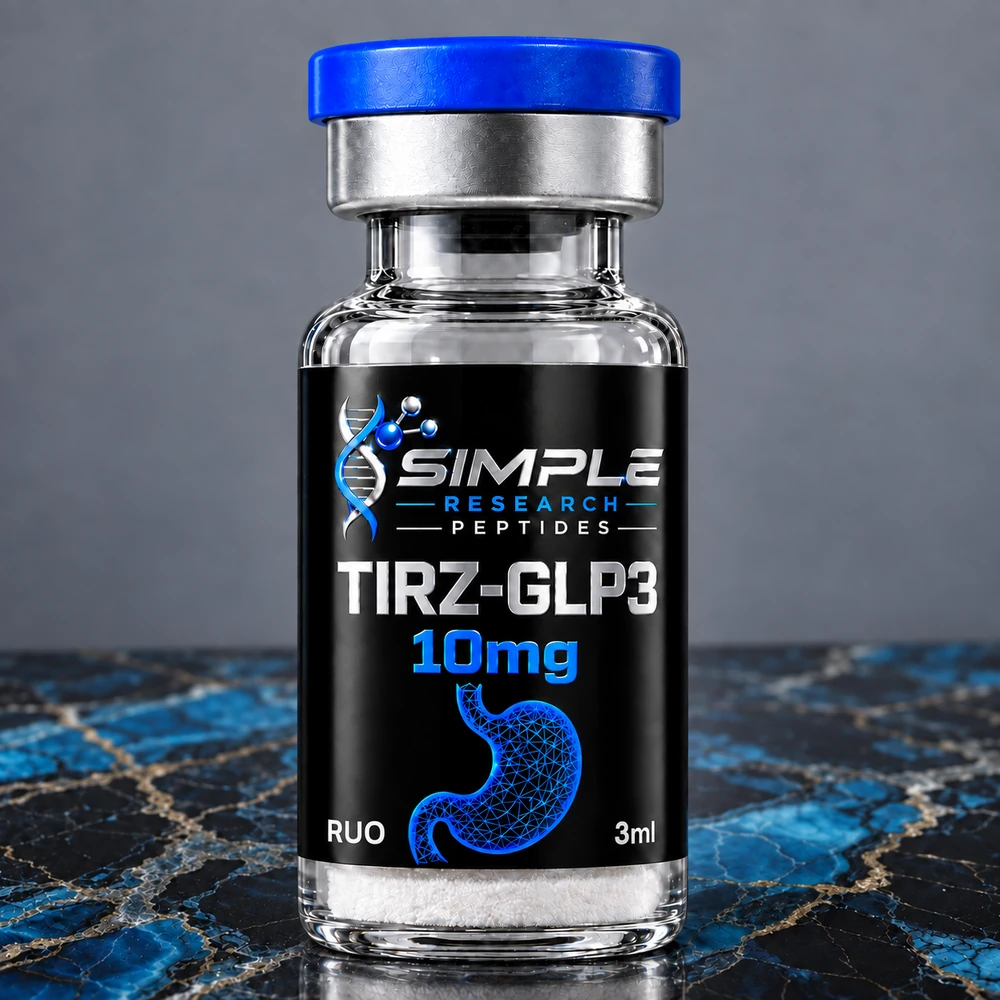
Tirzepatide Research Guide
An evidence-mapped overview of tirzepatide covering dual GIP/GLP-1 receptor pharmacology, clinical research, regulatory distinctions, and the limits of applying finished-drug evidence to research material.
Fast Answer
Tirzepatide is a synthetic peptide engineered to activate both the glucose-dependent insulinotropic polypeptide (GIP) receptor and the glucagon-like peptide-1 (GLP-1) receptor. It has been studied extensively in controlled trials involving type 2 diabetes, obesity, cardiometabolic outcomes, and weight maintenance.
The existence of FDA-approved tirzepatide medicines does not make every tirzepatide-labeled vial an approved drug. SRP research material is not Mounjaro or Zepbound, has not been reviewed as a finished medicine, and is offered only for laboratory research.
Why Researchers Study Tirzepatide
Tirzepatide provides a model for studying coordinated signaling through two incretin receptors. Researchers examine downstream effects involving insulin secretion, glucagon regulation, appetite-related signaling, gastric motility, energy intake, body composition, and cardiometabolic markers.
The dual-receptor design is the central scientific question: observed results may reflect combined pathway activity rather than a simple extension of single-receptor GLP-1 agonism.
Evidence Map
- Mechanistic evidence: receptor-pharmacology and metabolic studies support activity at both GIP and GLP-1 receptors.
- Clinical evidence: the SURPASS and SURMOUNT programs provide randomized human data for approved finished products and defined study populations.
- Body-composition evidence: a SURMOUNT-1 substudy found reductions in both fat mass and lean mass, making composition—not scale weight alone—an important research endpoint.
- Long-term questions: durability, discontinuation effects, rare adverse events, and outcomes across populations remain active research areas.
Regulatory and Evidence Limits
FDA warns that unapproved versions of tirzepatide do not undergo premarket review for safety, effectiveness, or quality. Research-only labeling must not be used to imply that an unapproved product is equivalent to an approved medicine.
Results from controlled trials cannot establish the identity, purity, sterility, potency, or clinical performance of separately sourced research material. This guide therefore summarizes published science without providing dosing, injection, or treatment instructions.
Frequently Asked Questions
Is tirzepatide the same as semaglutide?
No. Tirzepatide activates GIP and GLP-1 receptors, while semaglutide is designed primarily as a GLP-1 receptor agonist.
Is SRP tirzepatide an FDA-approved medicine?
No. SRP material is labeled for laboratory research only and is not an approved finished drug.
Does popularity prove safety or effectiveness?
No. Search demand and community discussion do not replace controlled evidence, product-quality review, or regulatory approval.