

Bronchogen 20mg — respiratory peptide research
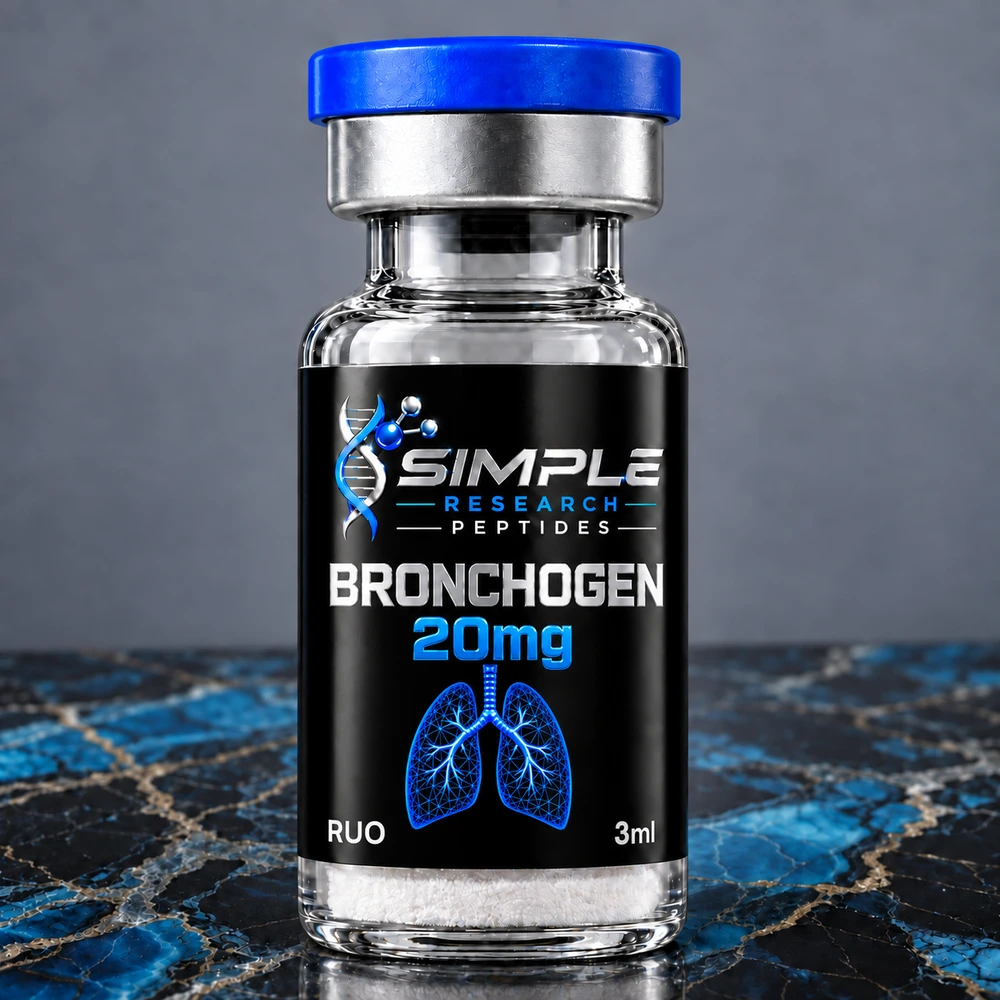
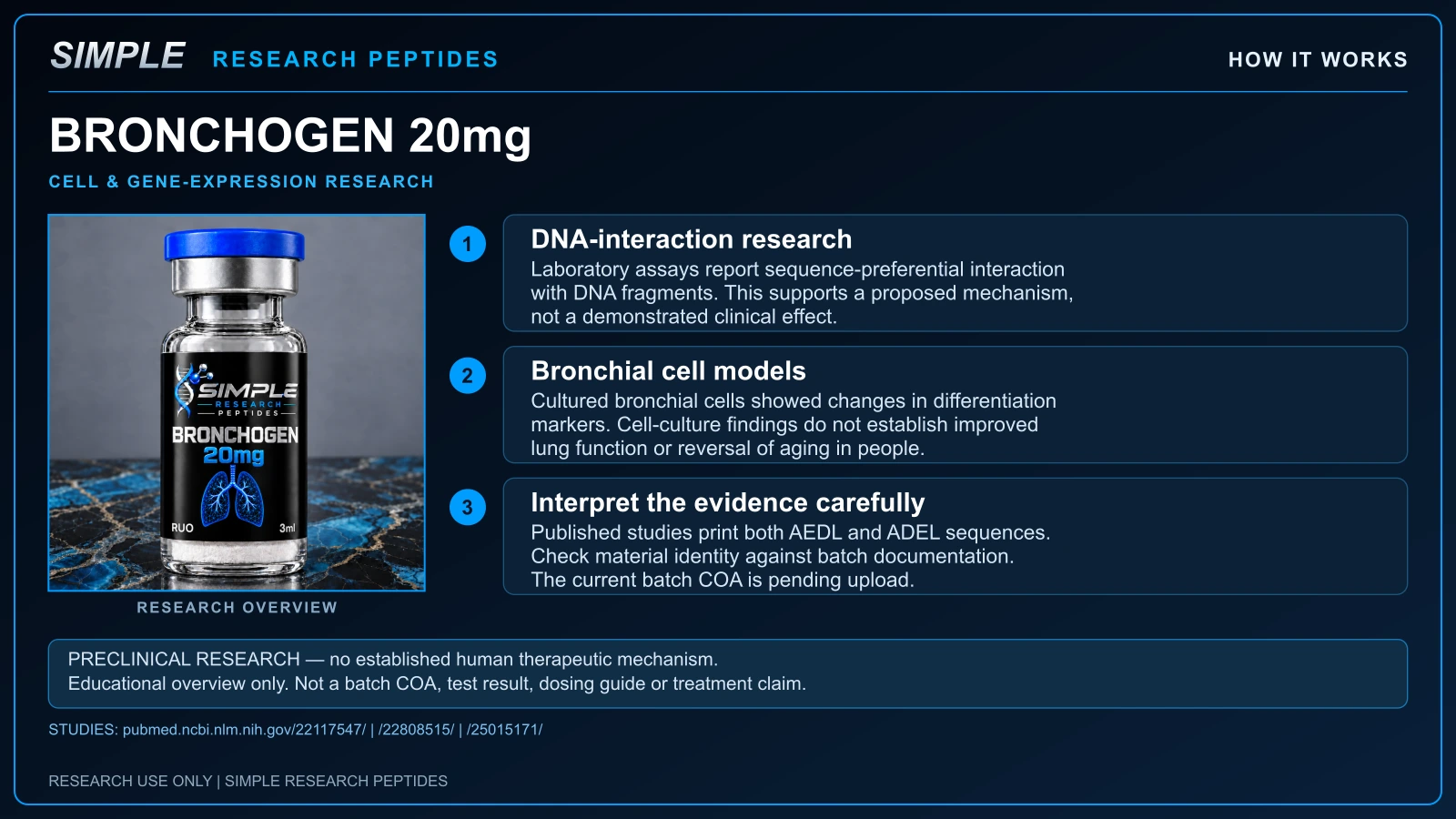
Bronchogen 20mg is offered by Simple Research Peptides as a single research vial in the peptide bioregulator catalogue. The 20mg designation identifies the listed amount per vial; the 3ml marking describes the vial’s nominal capacity, not a prepared solution concentration. Bronchogen appears in published work investigating short peptides, bronchial epithelial cell differentiation and interactions with DNA. These research areas provide the context for the blue lung illustration on the label and the accompanying SRP “How It Works” chart. The illustration is a visual guide to the research topic, and does not establish a clinical effect or verify the contents of an individual batch.
What the published studies investigate
A 2012 cell-culture study examined differentiation-associated markers in several tissue types and reported a tissue-dependent response to different short peptides. In bronchial epithelial cultures, the authors identified Bronchogen as Ala-Glu-Asp-Leu (AEDL) and described increased expression of the markers CXCL12 and Hoxa3, with a more pronounced response in later-passage cultures. This finding is relevant to experimental questions about how cultured epithelial cells retain or change their characteristics over successive passages. It should not be read as evidence that the product reverses aging or restores lung function in people: the experiment measured markers in cultured cells, rather than patient outcomes. Read the 2012 cell-differentiation study.
A separate biochemical study investigated interactions between short peptides and nucleic acids using fluorescence-based measurements. Its Bronchogen results describe preferential interaction with DNA fragments containing CTG sequences. This supports a laboratory hypothesis involving peptide–DNA recognition; it does not, by itself, demonstrate a complete pathway from DNA binding to a physiological benefit. The same paper also examined cellular entry of other labeled peptides, so those observations should not automatically be assigned to Bronchogen. Keeping the individual experimental systems separate helps researchers evaluate what each result actually establishes. Read the 2011 peptide–DNA interaction study.
Related bronchial-epithelium research published in 2014 measured gene expression and protein markers in human embryonic cell cultures at different passages, alongside cell-free DNA-interaction experiments. The paper reports the sequence Ala-Asp-Glu-Leu (ADEL), whereas the 2012 Bronchogen paper prints AEDL. These are different amino-acid orders and should not be treated as interchangeable without clarification. Researchers comparing the literature should check the sequence and material identity used in each experiment against supplier documentation. Accordingly, this listing does not assign an independently verified sequence to the current stock without a lot-matched analytical report. Read the 2014 bronchial-epithelium study and its stated sequence.
Animal-model evidence also appears in a 2015 study of nitrogen-dioxide-induced obstructive lung pathology in rats. The authors reported changes in bronchial tissue remodeling, ciliated cells and inflammatory measures after experimental Bronchogen administration. These results concern a specific induced disease model and its study conditions; they do not establish human effectiveness, clinical safety or an appropriate use regimen. Taken together, the cited papers offer starting points for preclinical literature review, with substantial differences between biochemical assays, cultured cells and whole-animal experiments. This product is for research use only and is not intended for human or veterinary use, diagnosis or treatment. Read the 2015 rat-model study.
Batch documentation and educational graphics
No batch-specific purity percentage, analytical identity result, sterility claim or laboratory certification is asserted here. The COA review, mass-spectrometry, lot-traceability and chromatography graphics in this gallery are prominently marked educational examples. Their diagrams and placeholder fields explain documentation concepts; they are not measurements from this Bronchogen stock and do not replace a lot-matched report. The batch report will be added when it is available. Follow the supplied product documentation for handling and storage requirements.

Reviews
There are no reviews yet.