
GHK-Cu
Also known as: Copper tripeptide-1, Glycyl-L-histidyl-L-lysine copper
Quick summary
GHK-Cu is a naturally occurring tripeptide that binds copper(II) tightly. Research focus: tissue remodeling, wound healing models and ligament graft healing. This page leads with SRP's low-and-slow starting dose.
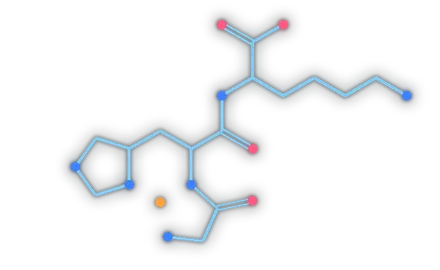
2D structure
Overview
GHK-Cu is a naturally occurring tripeptide that binds copper(II) tightly. It is found in plasma, saliva and urine. It is studied as a signal for tissue remodeling, collagen production and wound repair, in injectable and topical forms.
Looking for research material? Simple Research Peptides lists GHK-Cu Research Vials for laboratory research use.
Mechanism
GHK binds copper(II) tightly and may deliver it to tissues. Gene-expression studies link it to collagen and glycosaminoglycan synthesis and to remodeling of the surrounding tissue.
Research areas
- tissue remodeling
- wound healing models
- ligament graft healing
- topical formulation research
Storage & reconstitution
Lyophilized vials are kept cold and dry; the blue color comes from the copper complex. Labs typically reconstitute with bacteriostatic water, refrigerate the solution and protect it from light. Topical powder is stored sealed and dry.
Recommended starting dose (low and slow)
| Starting dose | 1 mg per administration. |
|---|---|
| Frequency | Reported for the injectable form at about 1-2 mg per administration, daily or several times a week. |
| Reconstitution | Example: 100 mg vial + 2.5 mL bacteriostatic water = 40 mg/mL (2 mg = 0.05 mL). Blue color is normal for the copper complex. |
Injectable ~1-2 mg per administration, daily or several times weekly; topical use is set by formulation concentration rather than mass.
Studied higher doses
Studies have used doses up to the amounts below. Higher doses can be dangerous. Whether a person can reach them safely depends on height, weight, activity level, training and pre-existing conditions. We recommend following the lower starting dose above, and contacting SRP with any questions.
| Highest amount reported in studies | 2 mg per administration in; allows 2.5 mg. Mostly agree. |
|---|---|
| Step-up schedules reported | Gives three fixed examples rather than steps: 1 mg five days a week for 4 weeks; 1-1.5 mg daily for 4-6 weeks; 1.5-2 mg daily for 6-8 weeks. |
Route and timing
Route: Subcutaneous injection or topical application, depending on the form.
Timing: Pending - to be added by SRP
Cycle length and repeat
Pending - to be added by SRP
Half-life
Approximate, for Bobby's review: Not well characterized in published research.
Side effects
Pending - to be added by SRP
Suggested bloodwork and monitoring
Draft, for Bobby's review: CBC and comprehensive metabolic panel (kidney and liver function, electrolytes) before starting and again after a few weeks; serum copper and ceruloplasmin for injectable use.
Cautions
Pending - to be added by SRP
Reconstitution calculator
Math aid only. It converts the numbers you enter; it is not dosing advice. For research use only. Prefilled with this page's vial size, reconstitution and low-and-slow starting dose where known; change any value.
Frequently asked questions
What is GHK-Cu studied for?
In research it is studied for tissue remodeling, wound healing models and ligament graft healing. GHK binds copper(II) tightly and may deliver it to tissues.
How is GHK-Cu given in research?
Subcutaneous injection or topical application, depending on the form. See the dosing frequency block on this page for how often.
What amount should a researcher start with?
This page lists SRP's low-and-slow starting dose in the Recommended starting dose section. Higher amounts that appear in studies are listed separately with their safety context. Start with the lower dose and contact SRP with any questions.
Related peptides
Last updated: October 19, 2026